
The main advantage of lamination is that it produces timber members larger than any tree can supply, that distort less and whose strength is known in advance. The disadvantages are the extra work of drying, gluing and pressing, the need for a specialised plant, and the difficulty of transporting large members.
So lamination is not the right answer for every job. For a simple short-span roof, well-dried solid timber is often adequate and cheaper. When the span is wide, the structure is exposed or the shape is curved, glulam comes into its own. We explain what glulam is and how it is made in our article on laminated wood; here we focus on the trade-offs.
Advantages of lamination
Freedom of size and shape
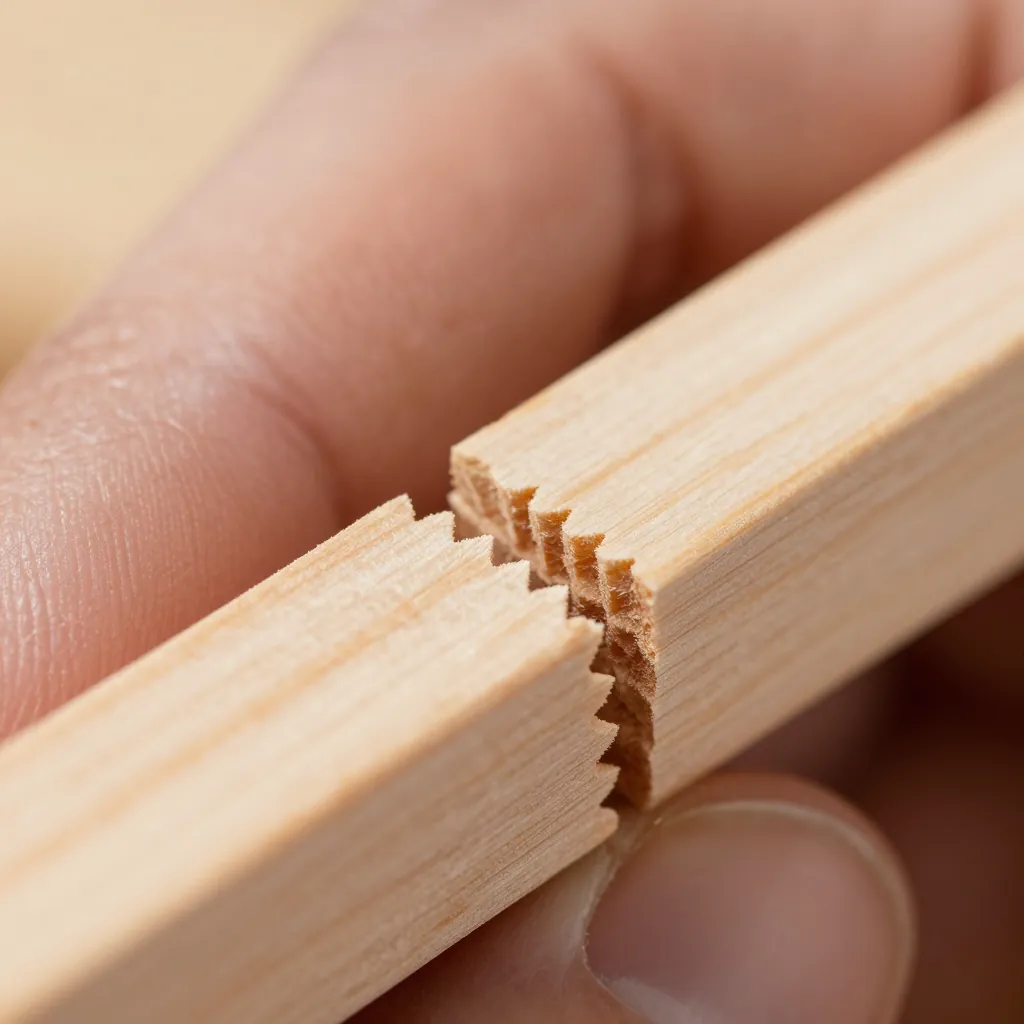
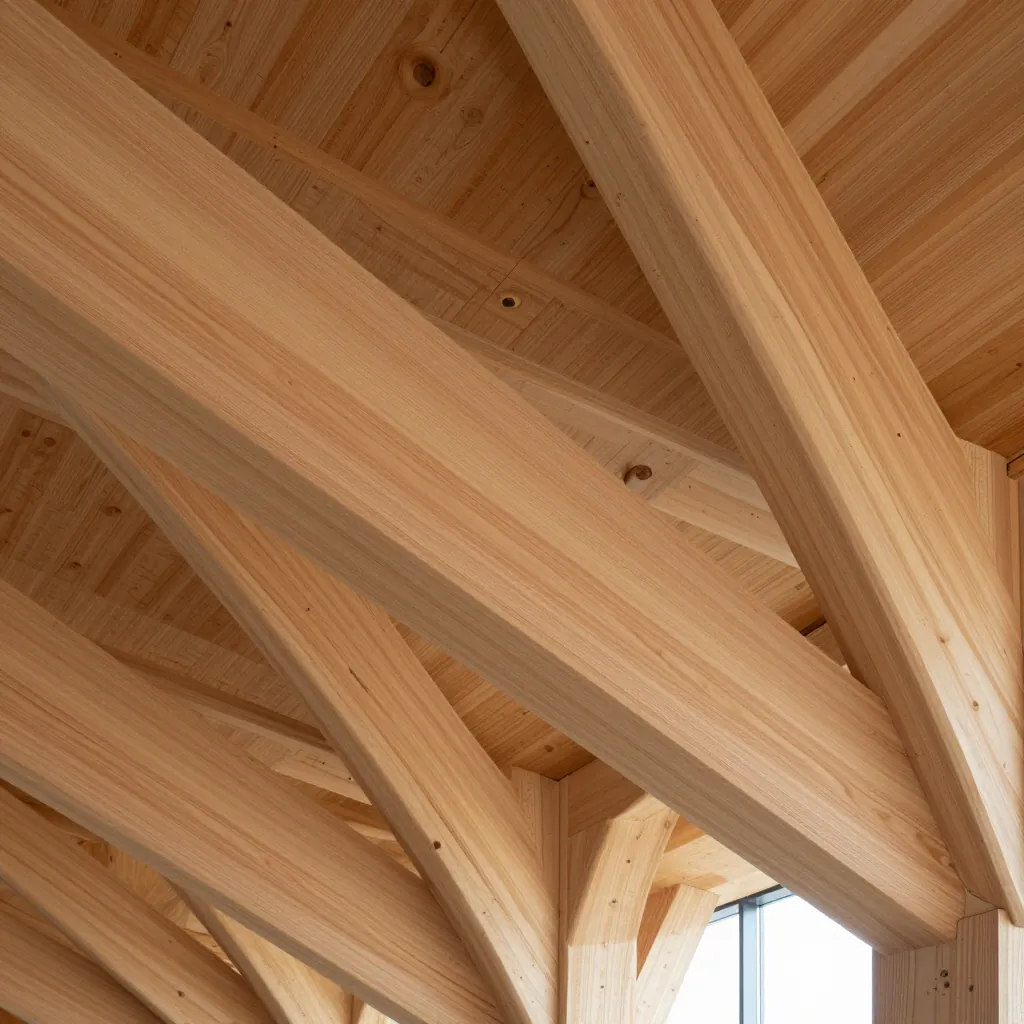
The length and section of solid timber are limited by the trunk. Once lamellae are joined end to end with finger joints and stacked, length and depth are limited mainly by the press and by transport. Arches, vaults, domes and tapered beams become possible, and a member can be made deeper exactly where the load is highest.
Better dimensional stability
Laminated members warp and check less than solid members of the same species. Contrary to what some older sources claim, this is not because the glue is “water-repellent”. The real reasons are:
- Thin lamellae can be dried evenly to their service moisture content, whereas the core of a thick solid section keeps drying for years.
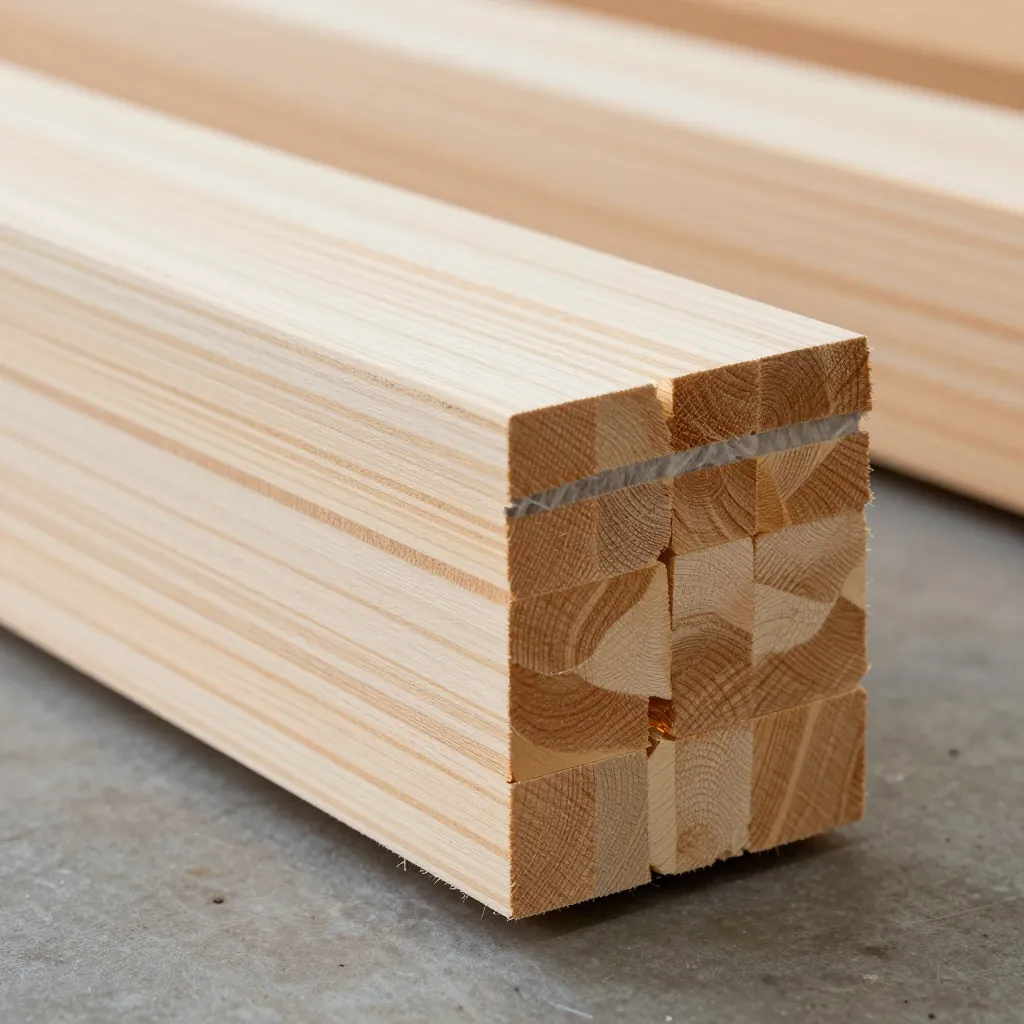
- Lamellae are laid with their growth-ring orientation balanced, so internal stresses offset each other.
- Each lamella’s tendency to move is restrained by its neighbours.
Defects removed and dispersed
Large knots, splits, decay and reaction wood are cut out, and the small defects that remain are spread across the section instead of concentrated at one point. As a result glulam strength falls within a narrow range and can be specified in classes such as GL24h or GL28h under EN 14080. In a solid beam of the same species, one large knot can govern the strength of the whole member.
Efficient use of raw material
Short pieces (from about 20 cm) and lumber from small-diameter logs can be used, reducing waste and the need for large, clear trees.
Factory-prepared, quick on site
Columns, beams, trusses and purlins are cut to size in the factory, with connection holes and steel hardware details prepared in advance. Assembly is fast, clean and dry.
Disadvantages of lamination
- Extra processing and cost: Drying, defect removal, finger jointing, planing, gluing and pressing are steps solid timber does not need. The price per cubic metre is higher, although a solid member of the same size is often simply unavailable.
- Dependence on bond quality: Strength depends not only on the wood but on the quality of the joints and glue lines. Structural adhesives are expensive, and temperature, humidity, open time and press pressure must be tightly controlled.
- Plant and expertise: Drying kilns, a finger-jointing line, large presses, a climate-controlled hall, a quality-control lab and experienced staff are all required.
- Transport: Long and especially curved members may need special vehicles, permits and cranes, so splice points should be planned at the design stage.
- Protection outdoors: Glulam is still wood. Members that stay wet can decay, so overhangs, drip details and a suitable finish are needed.
Glulam versus solid timber at a glance
| Property | Glulam | Solid timber |
|---|---|---|
| Available size | Limited by press and transport; very long, deep sections | Limited by the trunk |
| Shape | Straight, curved, tapered | Usually straight |
| Moisture | Uniform, around 12 % | Core of thick sections may stay wet |
| Warping and checking | Low | Medium to high |
| Strength | Narrow range, defined class (GL24h–GL32h) | Wide spread depending on defects (e.g. C16–C24) |
| Raw material yield | Short, small pieces usable | Needs large, good-quality logs |
| Unit price | Higher | Lower |
| Best for | Wide spans, exposed structure, curved forms | Short spans, concealed framing, packaging, general building |
Which should you choose?
If the span exceeds a few metres, the member will stay visible, tolerance for distortion is low or a curve is needed, lamination is usually the right choice. For short-span, concealed or temporary members, kiln-dried solid timber is more economical. The decision should weigh structural calculations, architectural intent and budget together.
Conclusion
Lamination is a proven way to move past the natural limits of wood: in return for more processing and investment it delivers size, stability and reliability. CNRWOOD produces glulam beams from timber dried to 12 % (± 2) moisture, in sections up to 150 × 150 mm and lengths up to 13,000 mm.