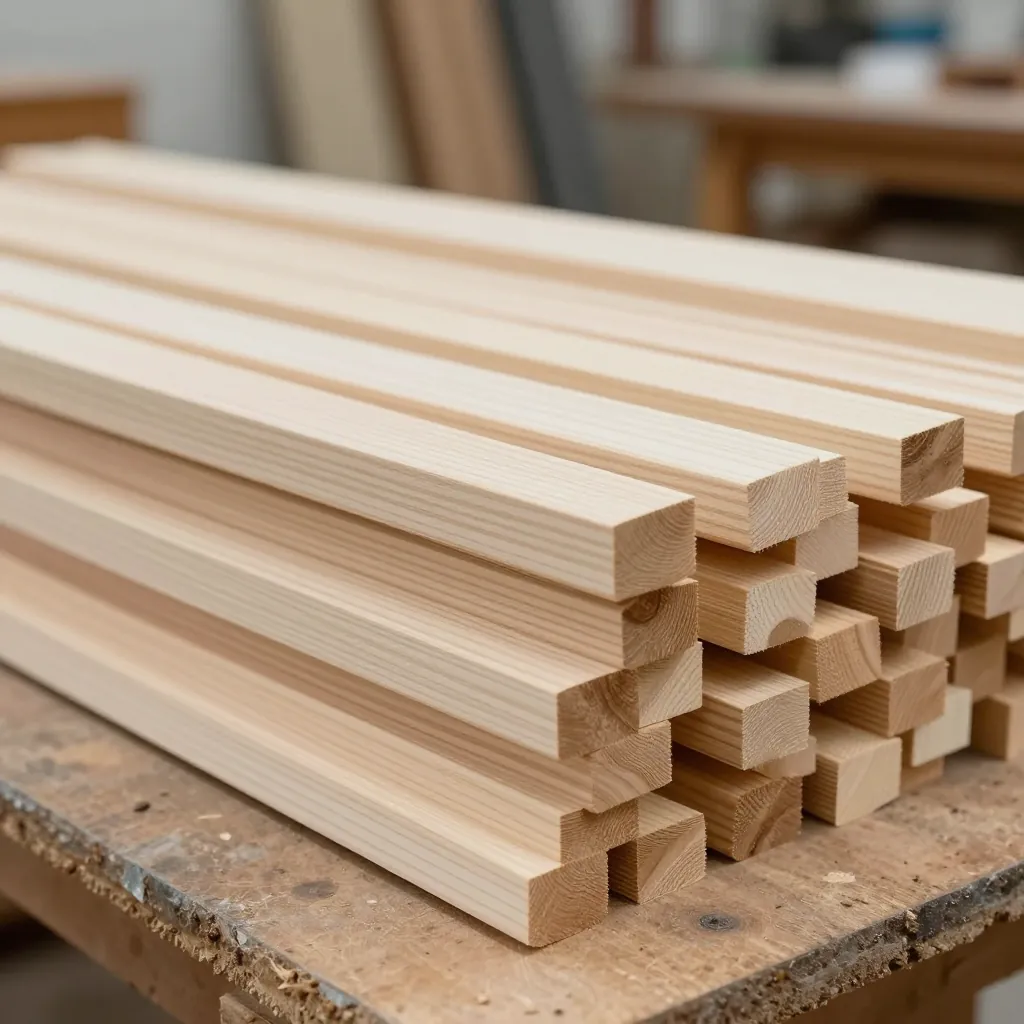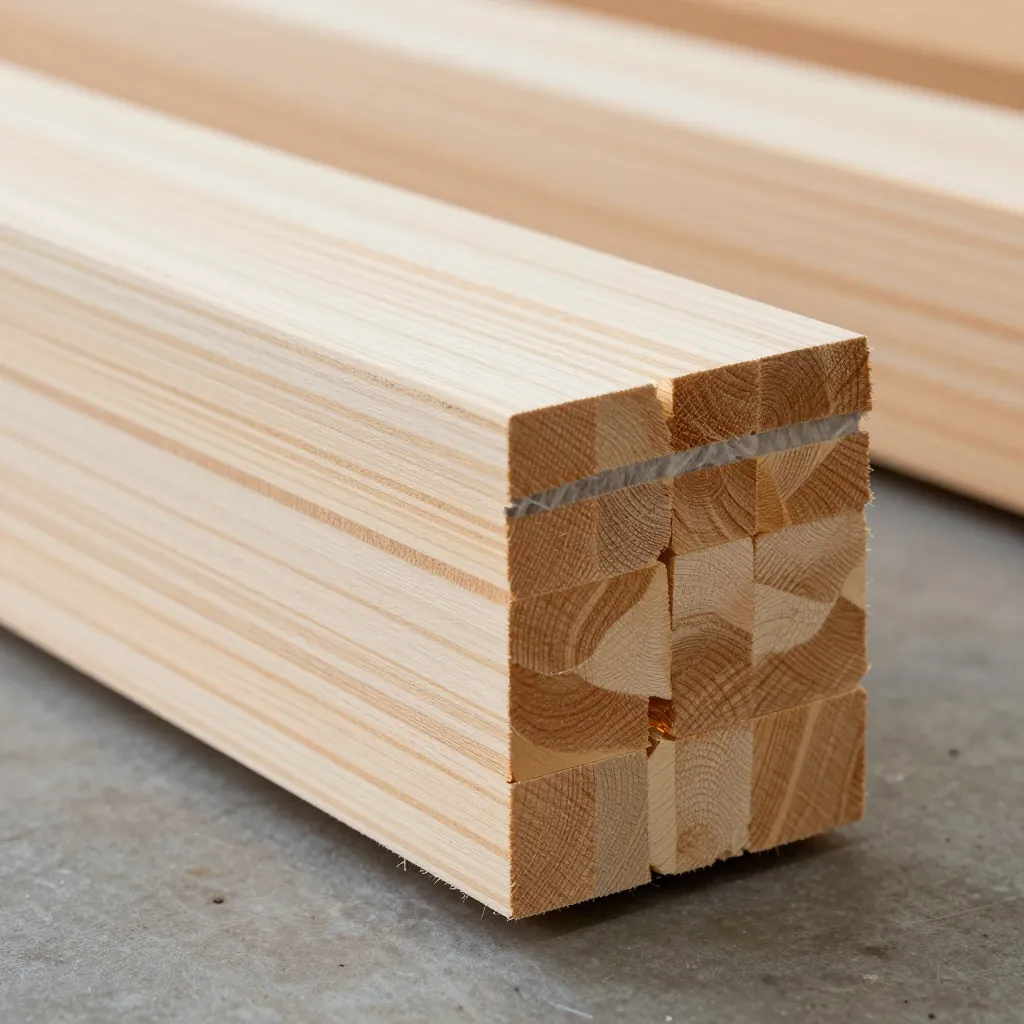

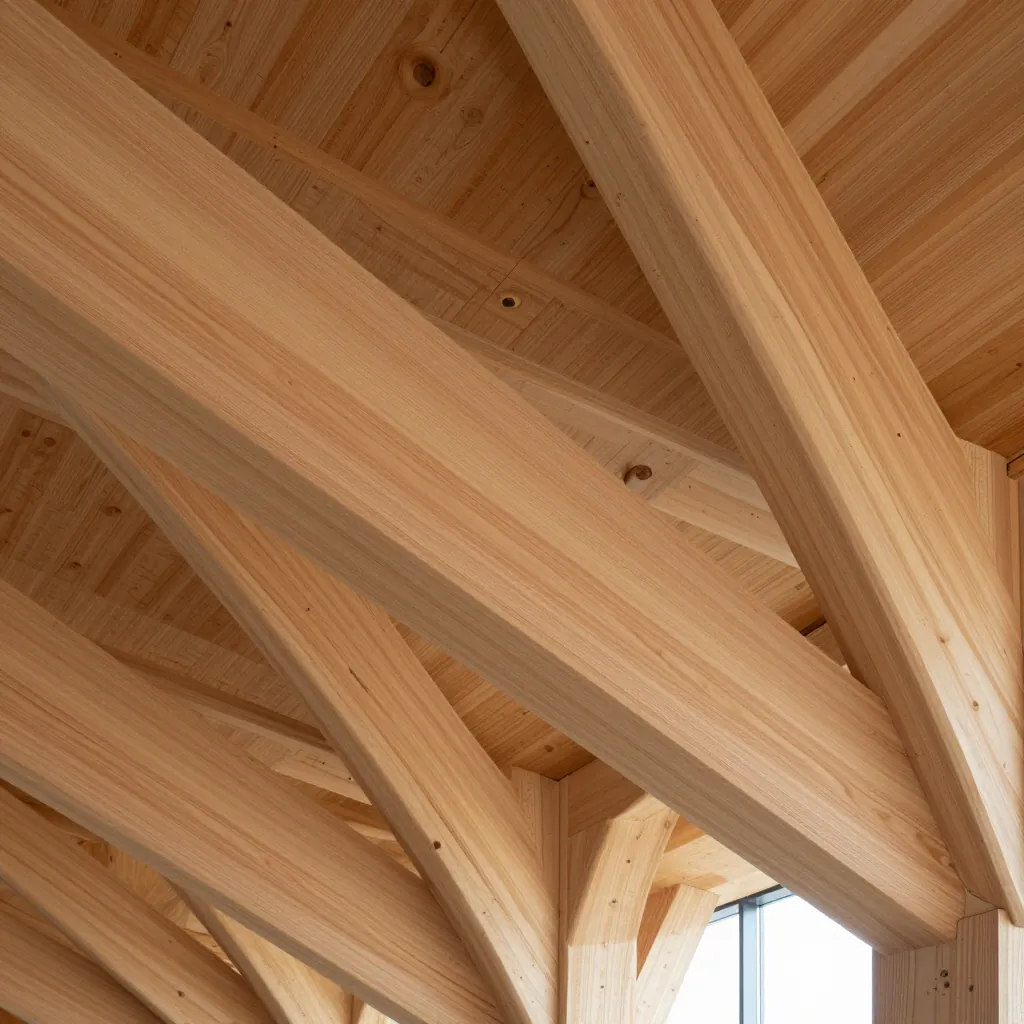
Glued laminated timber (glulam) is an engineered wood product made by bonding kiln-dried, strength-graded timber lamellae with structural adhesive so that the grain of every layer runs parallel to the length of the member. It allows columns, beams, arches and trusses in lengths and cross-sections that solid timber simply cannot provide.
The idea is straightforward. Cutting a large, defect-free beam from a single trunk is difficult and expensive. Stacking and bonding thin lamellae that have been cleaned of defects produces a member that is more uniform, more stable and has strength values engineers can calculate with confidence.
A short history
The pioneer of modern glulam was Otto Hetzer, a carpenter working in Weimar, Germany. In the early 1900s he patented glued laminated beams, and his 1906 patent covered curved laminated members. The system spread quickly to Switzerland and Scandinavia, where it was used for bridges, railway halls and large roofs. The first major glulam building in the United States went up in Wisconsin in 1934. After the Second World War, water-resistant synthetic adhesives made glulam reliable outdoors as well.
How glulam is made
- Drying: Lumber is kiln-dried to roughly 8–15 % moisture content before bonding. Keeping the moisture difference between adjacent lamellae small (usually no more than 4 %) prevents cracks and internal stress.
- Grading and defect removal: Lamellae are graded visually or by machine, and large knots, splits and decay are cut out.
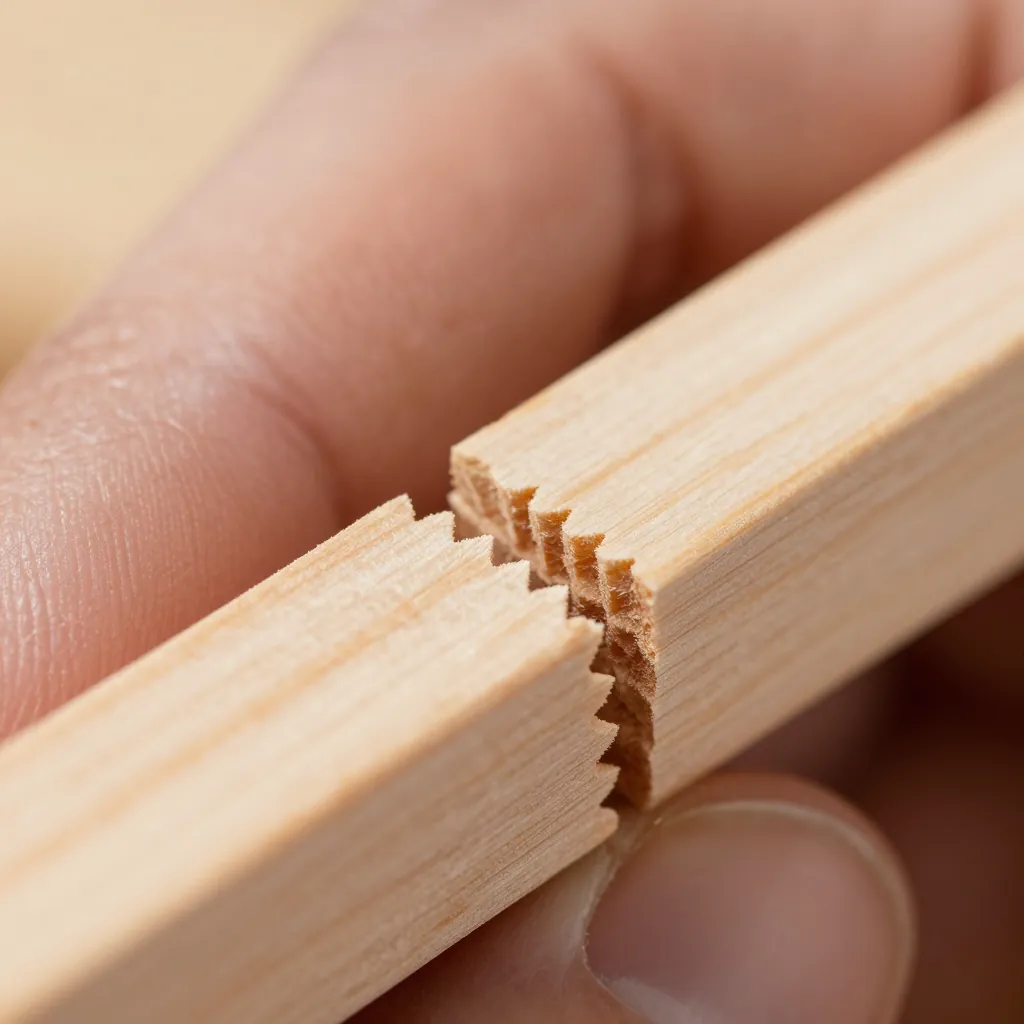
- End jointing: Short pieces are joined into continuous lamellae with finger joints.
- Planing and gluing: Lamellae are planed and glued immediately afterwards. Structural glulam uses MUF (melamine-urea-formaldehyde), PRF (phenol-resorcinol) or formaldehyde-free PUR (polyurethane) adhesives.
- Pressing: The lamella stack is clamped in a straight or curved jig and held under pressure until the adhesive cures.
- Finishing: The member is planed, cut to size and, where required, drilled and prepared for steel connections in the factory.
Under the European standard EN 14080, lamellae are generally no thicker than 45 mm, with a lower limit for members exposed to the weather. Curved members need thinner lamellae: Eurocode 5 applies no strength reduction for bending the lamellae when the inner radius is at least 240 times the lamella thickness.
Strength classes and technical values
Glulam is graded under EN 14080 with the letters GL. The number is the characteristic bending strength in N/mm². The suffix “h” means homogeneous (all lamellae of one class) and “c” means combined (higher-grade lamellae in the outer zones).
| Class | Bending strength (N/mm²) | Mean density (kg/m³) |
|---|---|---|
| GL24h | 24 | approx. 420 |
| GL28h | 28 | approx. 460 |
| GL30h | 30 | approx. 480 |
| GL32h | 32 | approx. 490 |
Wood barely moves along the grain (about 0.1–0.3 %), but it can shrink and swell by around 7–8 % tangentially and 4–5 % radially. Lamellae are therefore arranged with their growth rings balanced, so internal stresses cancel out and the member stays straight.
Fire, earthquakes and the environment
- Fire: Large timber sections form a protective char layer as they burn. Glulam chars at roughly 0.7 mm per minute while the unburnt core keeps carrying load, so a section can be oversized at the design stage to reach R30, R60 or R90 fire resistance. Unprotected steel, by contrast, loses strength rapidly as it heats.
- Earthquakes: Low self-weight reduces seismic forces, and well-designed steel connections help absorb energy.
- Environment: Trees store carbon as they grow; glulam keeps that carbon locked in for the life of the building and needs far less energy to produce than concrete or steel.
- Aggressive environments: Because it does not rust, glulam is a common choice for salt stores, swimming pools and agricultural buildings.
Glulam versus CLT
Both are made of bonded timber lamellae, but the grain direction differs. In glulam every lamella runs the same way, which makes it ideal for linear members such as beams and columns. In CLT (cross-laminated timber) the layers are laid at right angles, producing large wall and floor panels that are stable in both directions. LVL (laminated veneer lumber) is made of thin veneers and is a separate product; older sources that call glulam “Microlam” confuse the two.
Where glulam is used
- Wide-span buildings such as sports halls, pools, exhibition and concert halls
- Domes, vaults and arched roofs; pedestrian and road bridges
- Exposed structural frames in homes, restaurants and bungalows
- Pergolas, gazebos and decks outdoors, with suitable protection and detailing
Glulam has an attractive surface of its own and usually needs no cladding. It also combines easily with concrete and steel.
Glulam and CLT from CNRWOOD
Since 1998 CNRWOOD has produced glulam beams at its plant in Gebze, Türkiye, from timber dried to 12 % (± 2) moisture; linear members are laminated up to a 150 × 150 mm section and 13,000 mm length. For walls, floors and roofs it supplies CLT panels made from C24 spruce lamellae in lengths up to 16 m. For the trade-offs of the technique, see our article on the advantages and disadvantages of lamination.