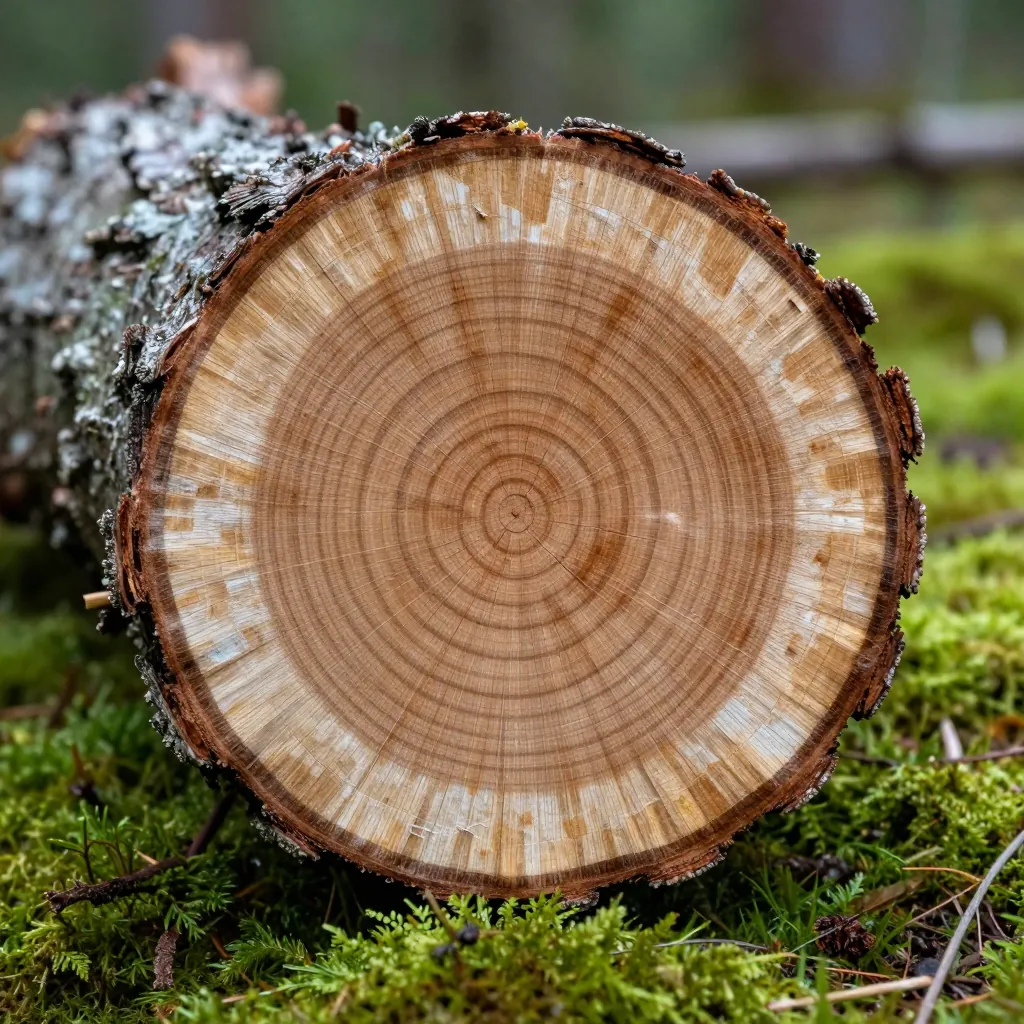

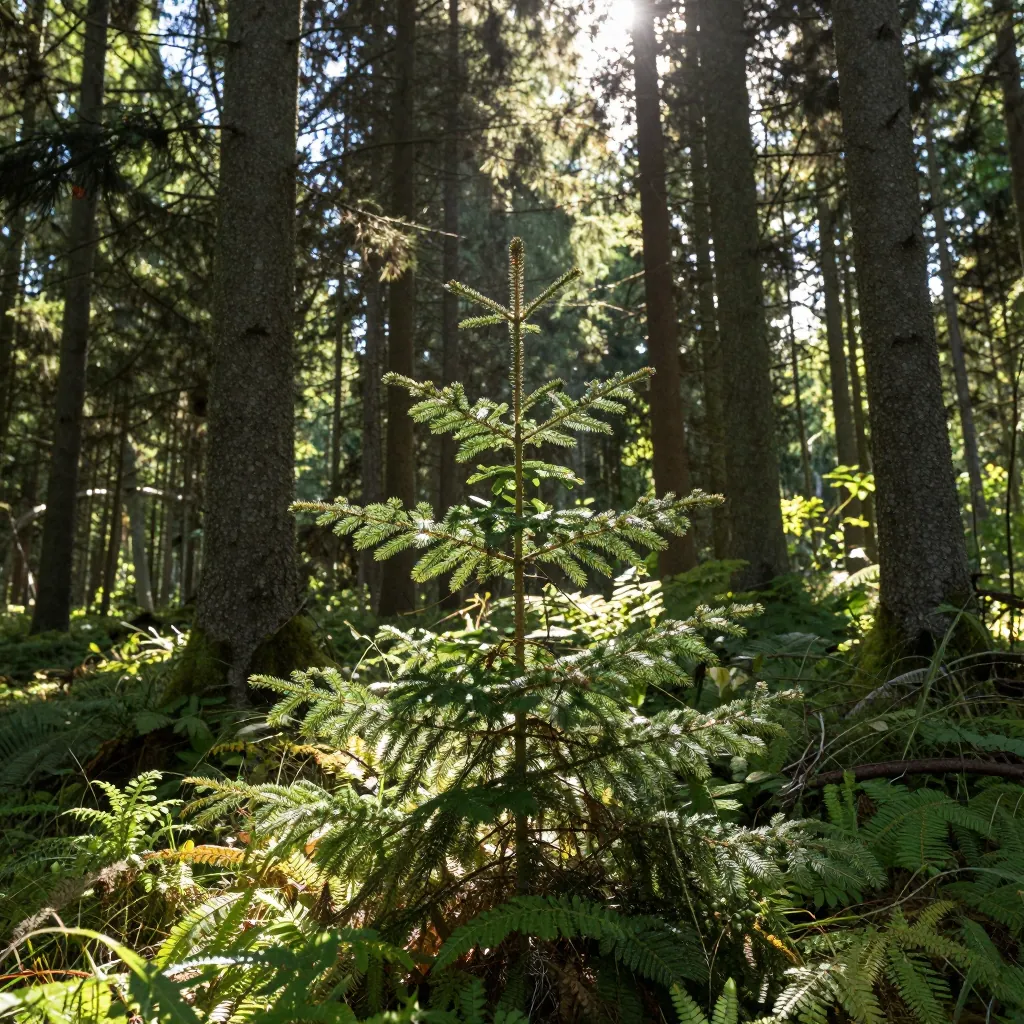
Trees grow in two separate ways. Height growth happens at the tips of shoots and roots, in growing points called apical meristems. Diameter growth happens in the cambium, a thin layer just under the bark that adds a new layer of wood every year and so creates the growth rings.
The energy comes from photosynthesis: leaves combine carbon dioxide from the air with water from the roots, using sunlight, to make sugars. Water and minerals from the soil are essential, but almost all the mass of wood is carbon taken from the air.
From Seed to Mature Tree: Development Stages
- Germination: with enough moisture and warmth the seed absorbs water, sends down a root first, then pushes the shoot and seed leaves above ground.
- Seedling: the first true leaves appear and the plant begins to feed itself. In forestry, nursery plants of one or two years are usually called seedlings.
- Sapling and youth: the stem becomes woody and height growth reaches its fastest phase. Trees compete for light; shaded lower branches die and fall, cleaning the trunk.
- Maturity: height growth slows, the tree produces seed regularly and the trunk keeps thickening. Timber is usually harvested in this phase.
- Old age: annual growth falls, the crown may die back and the trunk may decay. In some species this phase lasts centuries or even millennia.
Height Growth and Diameter Growth
Primary growth (height)
A tree gets taller only at its shoot tips. A nail driven into a trunk 1.5 m above the ground stays at 1.5 m for good; it is simply swallowed as the trunk thickens. Roots lengthen the same way, at their tips.
Secondary growth (diameter)
The cambium thickens trunks, branches and roots. It produces wood (xylem) towards the inside and inner bark (phloem) towards the outside, while a separate cork cambium renews the outer bark. Lignin is deposited in the walls of new wood cells, which harden and, in most cases, soon die to become water-conducting tubes.
Old texts say the cambium is “the only living part of a tree”. That is not accurate: the inner bark, parenchyma cells in the sapwood, roots, buds and leaves are alive too. Over the years the inner sapwood stops conducting water and turns into heartwood, as explained in our article ../../../en/blog/what-is-a-tree-structure-properties-and-types/.
How Growth Rings Form
In temperate climates the cambium rests in winter and restarts in spring:
- Earlywood (springwood): formed when water demand is high, with large, thin-walled, pale cells.
- Latewood (summerwood): formed towards late summer, with small, thick-walled, darker and denser cells.
One band of earlywood plus one of latewood make one annual ring. Wet, favourable years give wide rings; dry or cold years give narrow ones. Counting rings gives a tree’s age, and comparing their widths reveals past climate, a science called dendrochronology. In the tropics, where seasons differ little, many species show no clear rings.
Ring width also affects timber quality. In softwoods, narrow, even rings usually mean a higher share of latewood and therefore denser, stiffer wood. Very fast-grown stems contain more juvenile wood, which is lighter and more prone to distortion during drying.
The Fastest-Growing Trees
There is no single answer to “fastest”: height growth, volume growth and harvest age are different measures and vary strongly with climate. The values below are approximate ranges for typical plantations:
| Species | Typical harvest age | Dry density | Main uses |
|---|---|---|---|
| Paulownia | 8–12 years | 250–300 kg/m³ | Light furniture, boxes, veneer |
| Eucalyptus | 6–10 years (pulp) | 500–800 kg/m³ | Paper, chips, poles |
| Hybrid poplar | 10–15 years | 350–450 kg/m³ | Plywood, packaging, matches |
| Bamboo (a grass) | 3–5 years (culm maturity) | 600–800 kg/m³ | Scaffolding, flooring, crafts |
| Spruce (for comparison) | 60–120 years | about 450 kg/m³ | Construction timber, door stiles |
Paulownia
Native to East Asia, paulownia can add several metres of height a year in its early years on well-managed plantations and can be harvested after 8–12 years. In Türkiye it is sometimes called “Chinese poplar”, but it is not related to poplars and belongs to a separate plant family. Contrary to claims on older pages, its wood is not hard and dense but very light and soft. That lightness, easy machining and good dimensional stability make it valuable for light furniture, boxes and veneer, but not for structural timber.
Eucalyptus and poplar
Eucalyptus forms some of the world’s most productive plantations, notably in Brazil, and is cut after 6–10 years for pulp. In Türkiye the main fast-growing tree is poplar: hybrid poplar plantations on suitable alluvial soils reach harvest in 10–15 years and supply the plywood, packaging and match industries.
Bamboo is not a tree
Bamboo is among the fastest-growing plants on earth; some species have been measured growing close to 1 m in a day. But bamboo is a giant grass, not a tree: it has no cambium, does not grow in diameter and forms no growth rings.
Is Fast Growth Always Better?
Fast-growing species produce a lot of biomass quickly, but in structural use the price is usually low weight, lower strength and a greater tendency to warp. That is why slow-grown northern spruce and pine remain the standard for load-bearing products such as door stiles, CLT and glulam. You can see the species CNRWOOD processes on our ../../../en/products/timber/ page, and read about record-breaking trees in ../../../en/blog/oldest-and-tallest-trees-in-the-world-and-turkiye/.