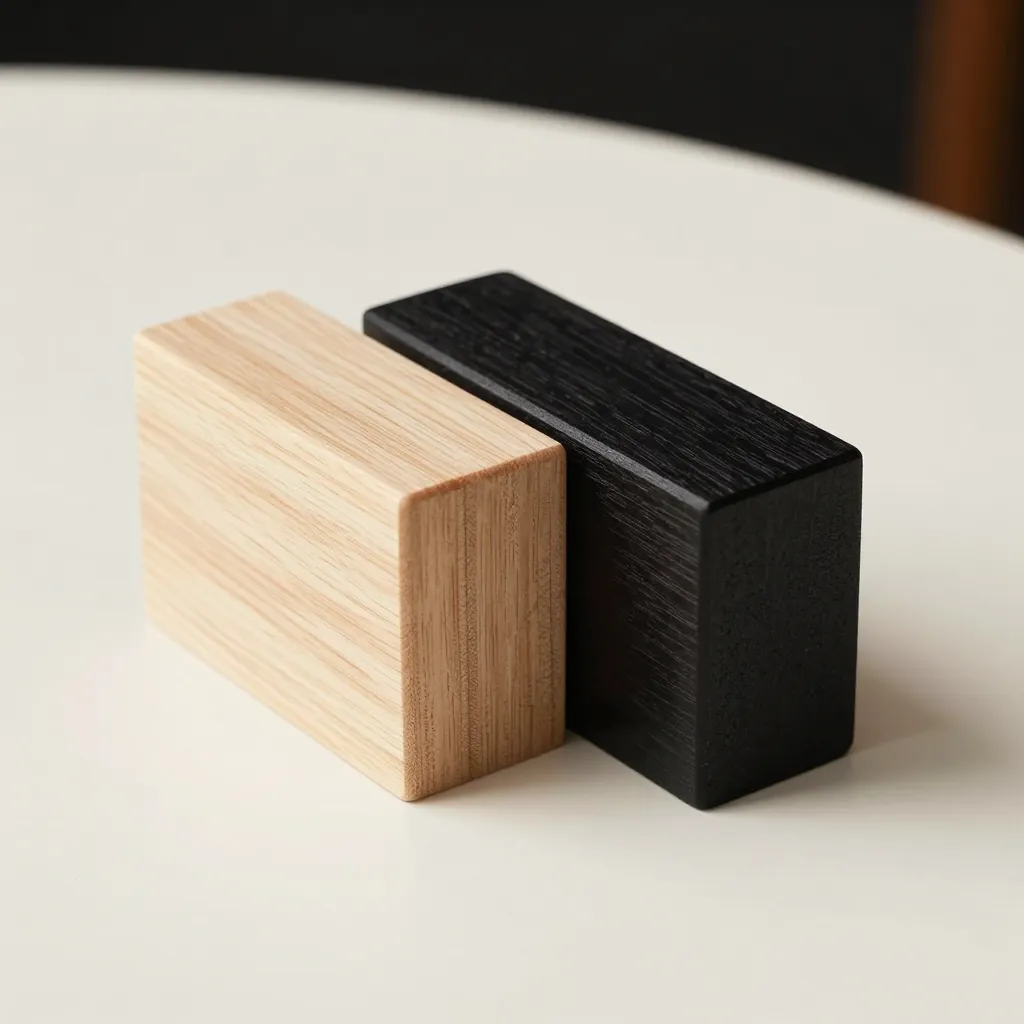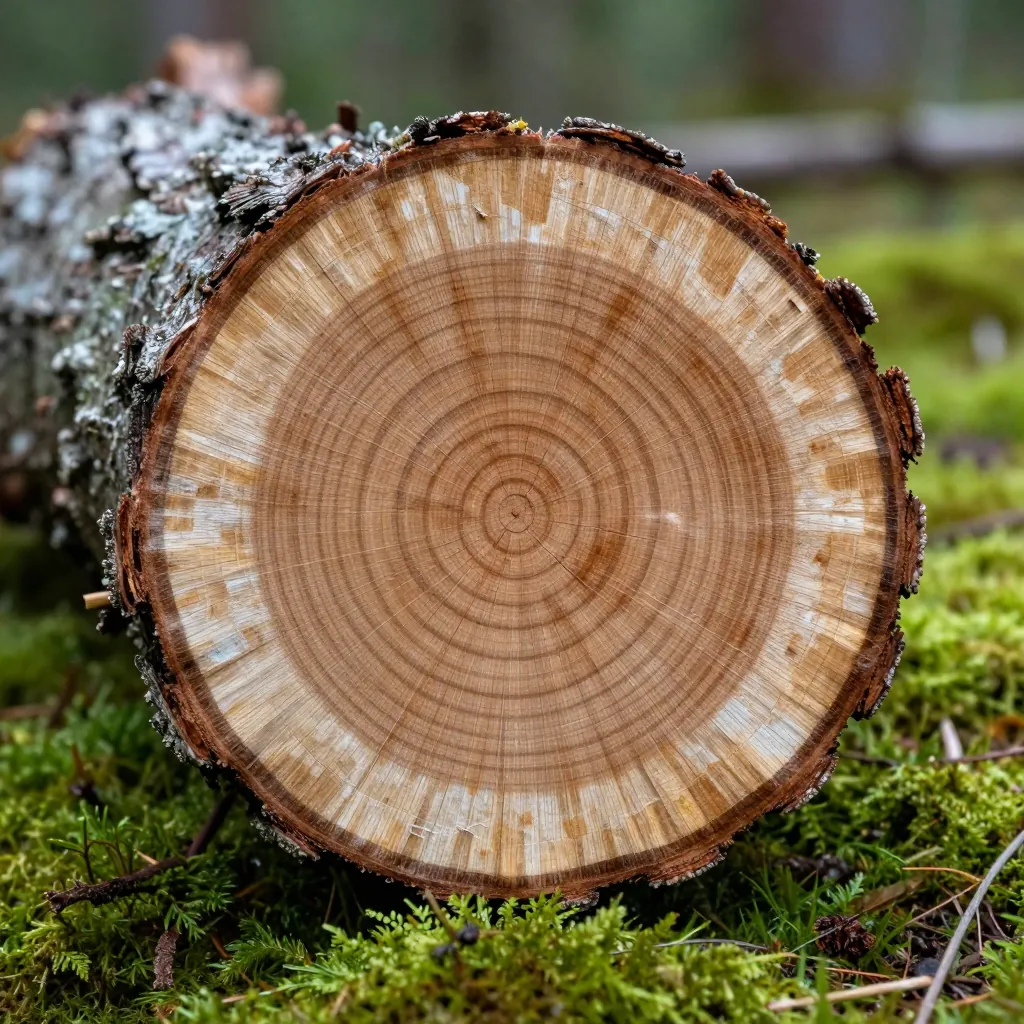

The physical properties of wood are the characteristics that can be measured without changing its structure or chemistry: moisture content, density, shrinkage and swelling, thermal conductivity, electrical conductivity and acoustic behaviour, together with appearance properties such as colour, lustre, odour and grain. They are closely linked, and moisture is the master variable: density, dimensions, heat conduction and electrical resistance all change as moisture content changes.
Wood is anisotropic. It behaves differently along the grain (longitudinal), across the growth rings (radial) and tangent to the rings (tangential). Understanding these properties when buying, drying and designing with timber prevents most cracks, distortion and open joints.
Moisture content: where everything starts
Moisture content is the mass of water in wood expressed as a percentage of its oven-dry mass: MC (%) = (wet mass − oven-dry mass) / oven-dry mass × 100. Because of this definition, freshly felled wood can exceed 100% moisture content.
- Free water sits in the cell cavities; bound water is held inside the cell walls.
- The point at which the cell walls are saturated but no free water remains is the fibre saturation point, around 25–30% for most species. Below it, wood starts to shrink and becomes stronger.
- Wood settles at an equilibrium moisture content set by the temperature and relative humidity around it. At 20 °C and 65% relative humidity this is about 12%; in heated interiors it can drop to 8–10%.
In practice, timber should be dried close to the equilibrium moisture content of its final location: about 8–12% for interior joinery and furniture, 15–18% outdoors. Wood that stays above about 20% is at risk of fungal decay, a topic we cover in our article on wood durability.
Density and weight
Density is mass divided by volume. Since both change with moisture, the moisture content must always be stated. The most common figure is air-dry density at 12% moisture content; foresters also use basic density, the oven-dry mass divided by the green volume.
The cell-wall substance itself has a density of about 1500 kg/m³ in every species. The large differences between species come from cell-wall thickness and the share of empty space. Air-dry density is therefore about 150 kg/m³ for balsa, 450 kg/m³ for spruce and 700 kg/m³ for oak, while some tropical species exceed 1200 kg/m³. We compare the lightest and heaviest timbers in this article.
Density is the best single indicator of strength, hardness and fuel value: within a species, heavier pieces are usually stronger and harder. Ring width on its own is a poor indicator; in softwoods, what really drives density is the share of dark latewood within each ring.
Shrinkage and swelling (wood “movement”)
Below the fibre saturation point, wood shrinks as it loses moisture and swells as it takes moisture up. The movement differs greatly by direction:
- Longitudinal: only 0.1–0.3%, negligible in practice.
- Radial: typically 3–6%.
- Tangential: typically 6–12%, roughly twice the radial value.
| Species | Radial shrinkage | Tangential shrinkage | Volumetric shrinkage |
|---|---|---|---|
| Norway spruce | ~3.6% | ~7.8% | ~12% |
| Scots pine | ~4.0% | ~7.7% | ~12% |
| European oak | ~4.5% | ~9.0% | ~13–15% |
| European beech | ~5.8% | ~11.8% | ~18% |
Total shrinkage from green to oven-dry; approximate averages from the technical literature.
The gap between radial and tangential shrinkage is the main reason flat-sawn boards cup and why end checks and splits form in logs and thick sections. Quarter-sawn timber moves more evenly. Cross-layered products such as plywood and CLT lock the layers against each other and greatly improve dimensional stability. Delivering and installing timber at the right moisture content keeps later gaps and distortion to a minimum.
Heat, electricity and sound
Thermal conductivity, expansion and fire
The air in its cells makes wood a good thermal insulator. Thermal conductivity ranges from about 0.10 to 0.18 W/(m·K) depending on species and moisture; a typical value for spruce is around 0.13 W/(m·K). That is roughly a tenth of concrete and hundreds of times lower than steel. Dense and moist wood conducts heat better than light, dry wood. Thermal expansion along the grain is very small, so temperature causes far less movement in wood than moisture does.
In a fire, large timber sections form a surface layer of char that insulates the wood beneath. Charring advances at a predictable rate, about 0.65–0.8 mm per minute for softwoods, and engineers use this rate to calculate the fire resistance of heavy timber members.
Fuel value: the calorific value of oven-dry wood varies little by species, about 18–20 MJ/kg, with resinous softwoods slightly higher per kilogram. Per unit of volume, dense species deliver more heat. Contrary to an old myth, wet wood gives less heat than dry wood, because part of the energy is spent evaporating water. Firewood should be below 20% moisture content.
Electrical conductivity
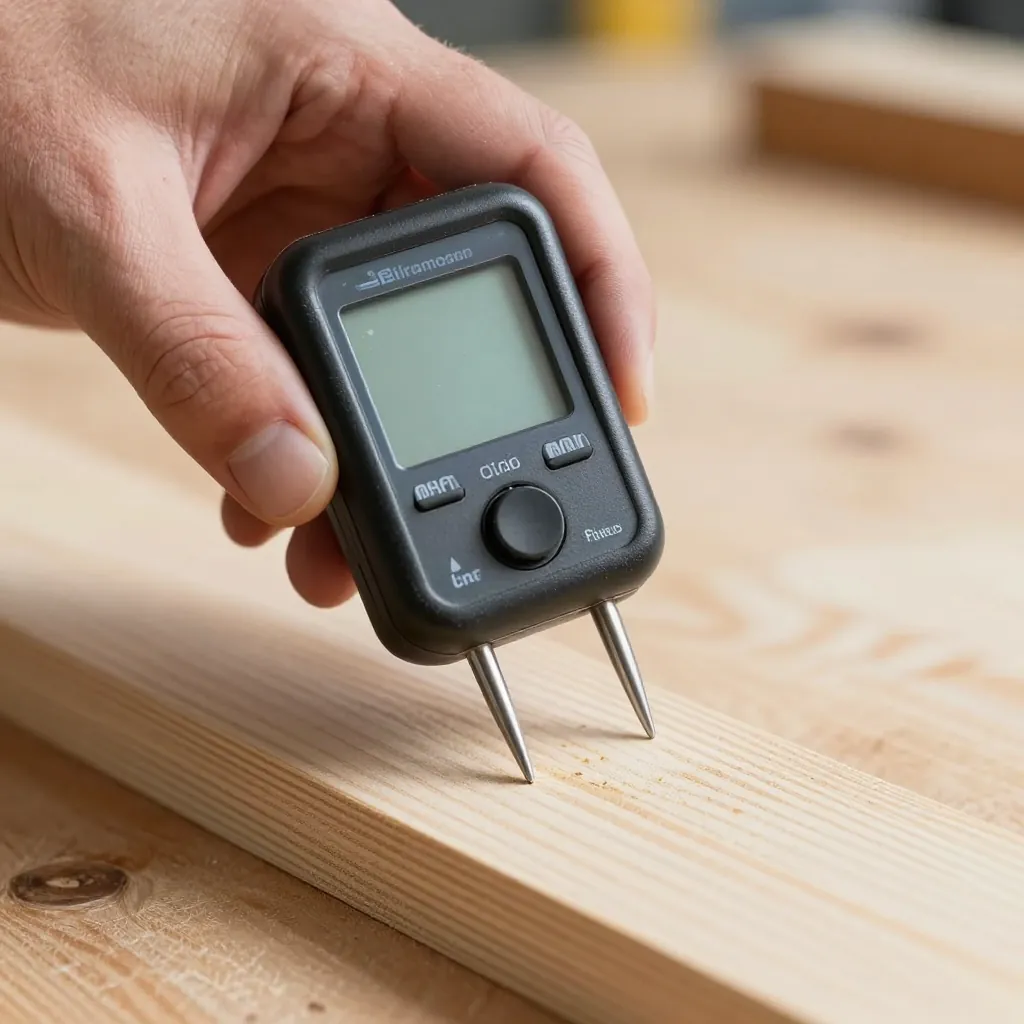
Oven-dry wood is an excellent electrical insulator. As moisture rises towards the fibre saturation point, electrical resistance falls by several orders of magnitude; above that point it changes much less. Pin-type moisture meters rely on this: they measure resistance between two electrodes and convert it to moisture content using species and temperature corrections, so the meter must be set to the right species. Wet wood should be treated as conductive and never relied on as an insulator.
Sound and acoustics
Sound travels very fast along the grain: about 5000–6000 metres per second in spruce. Its high stiffness relative to its low density makes spruce the classic material for the soundboards of violins, guitars and pianos. Fine, even, closely ringed wood transmits sound best.
The same property helps when checking logs: tap one end and sound wood gives a clear, ringing note, while internal decay produces a dull, muffled sound. In room acoustics, flat wooden surfaces mostly reflect sound; for absorption, perforated or slatted wood panels are combined with an absorbent layer behind them.
Colour, lustre, odour and grain
- Colour: heartwood is usually darker than sapwood because of its extractives. Light, especially UV, changes colour over time: some species darken, and wood left outdoors turns grey.
- Lustre: the ability of a cut surface to reflect light. It depends on cell structure, particularly the rays; on radial surfaces, broad-rayed species such as oak and plane show a distinct sheen. The old claim that lustre comes from starch is not correct.
- Odour: comes from resins, essential oils and tannins. In some species such as cedar and juniper it lasts for years; in most it fades as the wood dries.
- Grain and figure: growth rings, knots, sawing direction and fibre orientation (straight, wavy, or interlocked as in iroko and mahogany) define the look of the wood.
Hardness and wear resistance
Hardness bridges physical and mechanical properties and rises closely with density. On the Janka scale, Norway spruce scores about 1700 N, European oak about 5400 N and European beech about 6500 N. Teak is medium-hard, not soft as some old lists claim. End-grain surfaces resist wear better than side grain, which is why end-grain blocks are used for heavy-traffic floors. For a fuller comparison see our article on softwoods and hardwoods.
Conclusion
Almost every physical property of wood is tied to moisture. Timber dried to the right moisture content, in a species and cut suited to its environment, performs reliably for years. That is why at CNRWOOD we pay close attention to moisture and species selection in our timber and panels.