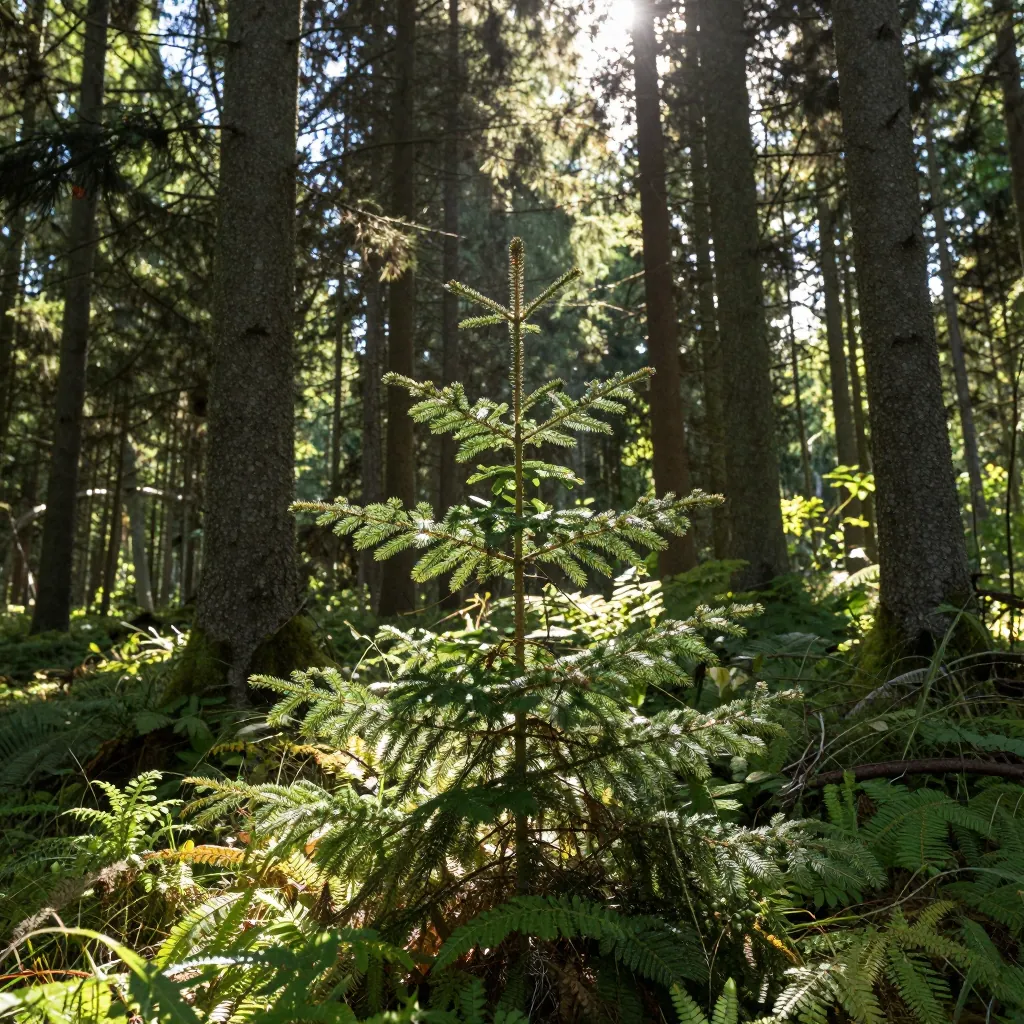

A tree is a long-lived woody plant made up of roots, a single main stem (the trunk) and a crown of branches and leaves. Unlike a shrub, it usually grows to several metres and its trunk thickens every year by adding a new layer of wood.
That accumulated wood is the raw material of logs, lumber, plywood and engineered timber. Understanding how a tree is built therefore explains why wood is very strong in some directions and sensitive in others.
The Three Main Parts of a Tree
- Roots anchor the tree, take up water and minerals and store reserves. Most of them spread in the top 60 cm of soil.
- The trunk carries the crown, moves water up to the leaves and sugars down to the roots. Almost all commercial wood comes from it.
- The crown is where photosynthesis takes place: carbon dioxide and water are turned into sugars using sunlight, and those sugars are built into the cellulose and lignin that make up wood.
The Trunk in Cross-Section: From Bark to Pith
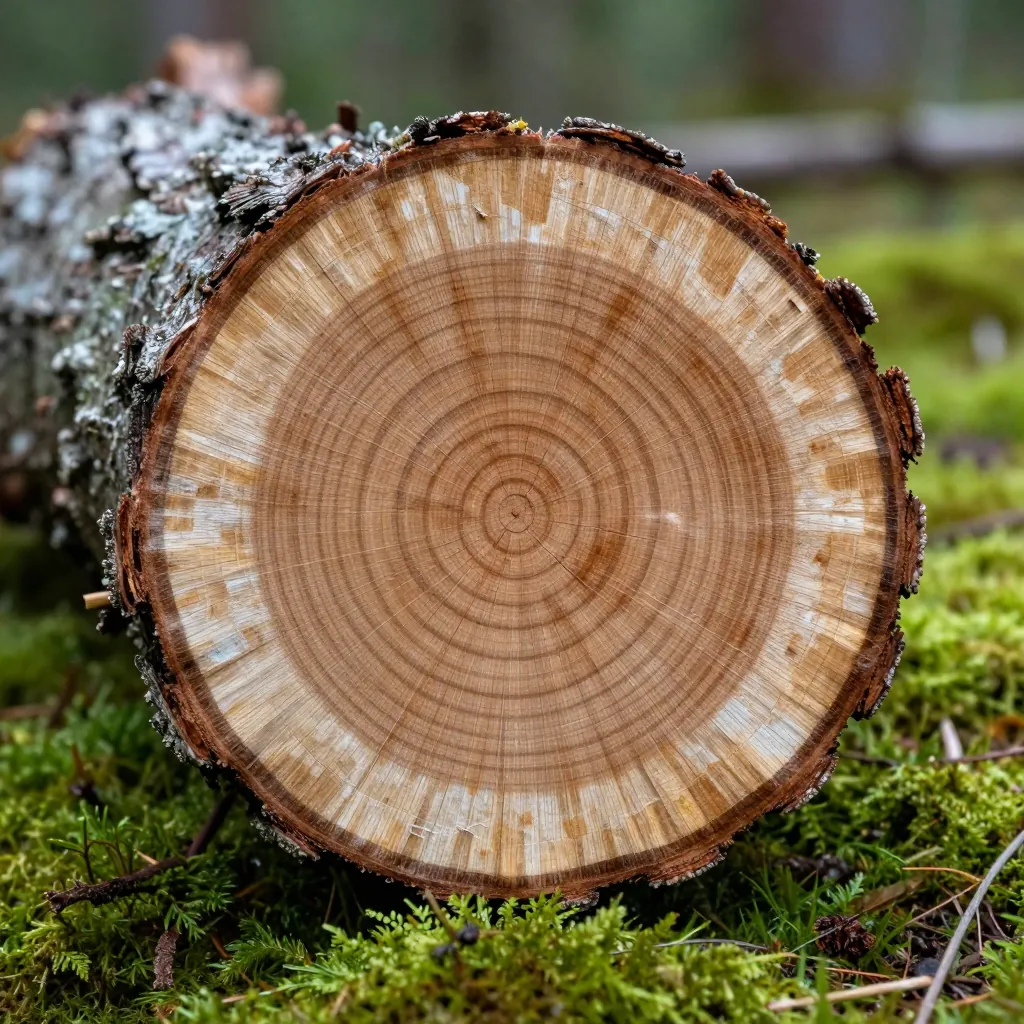
Cut a trunk across and you see, from the outside in:
- Outer bark: dead tissue that protects the tree against drying out, impact, fire and pests.
- Inner bark (phloem): living tissue that carries sugars from the leaves to the rest of the tree.
- Cambium: a very thin layer of dividing cells. It produces new wood (xylem) on its inner side and new phloem on its outer side, which is how the trunk grows in diameter.
- Sapwood: the usually pale outer wood that conducts water. It still contains living cells (parenchyma).
- Heartwood: inner wood that no longer conducts water. Its cells are dead and it provides mechanical support. In many species it darkens as tannins, resins and other extractives are deposited, which also makes it more resistant to decay.
- Pith: a few millimetres of soft tissue at the very centre, left over from the sapling stage.
Thin lines running from the centre towards the bark are rays. They move and store nutrients horizontally; in oak they are large enough to create the silvery figure seen on quarter-sawn boards.
Sapwood versus heartwood
Older translations sometimes call sapwood “false wood”; the correct term is simply sapwood. “False heartwood” is something else: an irregular dark core, such as the red heart of beech, that forms without true heartwood formation. In spruce, fir and beech the heartwood does not change colour and can only be told apart by its lower moisture content; in pine, oak and cedar the difference is obvious. In practice heartwood resists insects and fungi better, while sapwood absorbs preservatives far more easily, which matters for ../../../en/blog/what-is-wood-impregnation-and-impregnated-wood/.
Technical Properties of Wood
Wood is a natural composite of fibre-like cells aligned with the trunk. Their walls are built from three polymers:
| Component | Share (dry mass) | Role |
|---|---|---|
| Cellulose | 40–50 % | Tensile strength along the grain |
| Hemicelluloses | 20–35 % | Binds the cellulose fibres; governs moisture behaviour |
| Lignin | 18–35 % | Glues cells together; gives stiffness and compressive strength |
By element, wood of almost any species is roughly 50 % carbon, 44 % oxygen and 6 % hydrogen, with nitrogen and minerals below 1 %. (A formula such as “O4, H3, C2”, quoted on some old pages, does not describe wood.)
The key engineering properties follow from this structure:
- Anisotropy: wood is far stronger along the grain than across it. When drying, tangential shrinkage is about twice the radial shrinkage, while longitudinal shrinkage is usually only 0.1–0.3 %.
- Hygroscopicity: wood exchanges moisture with the surrounding air, which is why timber kiln-dried to the moisture of its end use moves much less.
- Density: dry density ranges from about 150 kg/m³ (balsa) to over 1,000 kg/m³. Spruce is around 450 kg/m³, oak around 700 kg/m³.
- Strength-to-weight ratio: weight for weight, wood competes with steel and concrete, which is the basis for building with CLT and glulam.
For density and other values, see our article on ../../../en/blog/physical-properties-of-wood-moisture-density-shrinkage/.
Types of Trees: Softwoods and Hardwoods
Trees fall into two botanical groups, traded as softwoods and hardwoods. The names describe the group, not the hardness: yew is a hard softwood and balsa, one of the lightest woods, is a hardwood. Our article on ../../../en/blog/softwood-vs-hardwood-what-is-the-difference/ goes into more detail.
- Softwoods (conifers): Scots pine, Austrian (black) pine, Turkish red pine, stone pine, spruce, fir, cedar, cypress, juniper and yew. Their wood consists mainly of long cells called tracheids; it is straight-grained and easy to machine, and it is the main material for construction lumber, door stiles and packaging.
- Hardwoods (broadleaves): oak, beech, hornbeam, ash, maple, chestnut, walnut, poplar, lime, birch, plane, alder, sweetgum and eucalyptus. Their wood contains vessels (pores) that conduct water; they dominate furniture, flooring and decorative work.
Deciduous or evergreen?
“Conifer = evergreen, broadleaf = deciduous” is a useful rule of thumb but not a law. Larch is a conifer that drops its needles in winter, while olive, bay, holm oak and eucalyptus are evergreen broadleaves.
From Tree to Product
A tree’s structure sets the quality of what is made from it: straight-grained, low-knot, evenly dried wood moves less and carries more load. At CNRWOOD we process softwood, mainly spruce and pine, into kiln-dried lumber, door stiles, CLT, glulam and ISPM 15 crates. Species and sizes are listed on our ../../../en/products/timber/ page.