
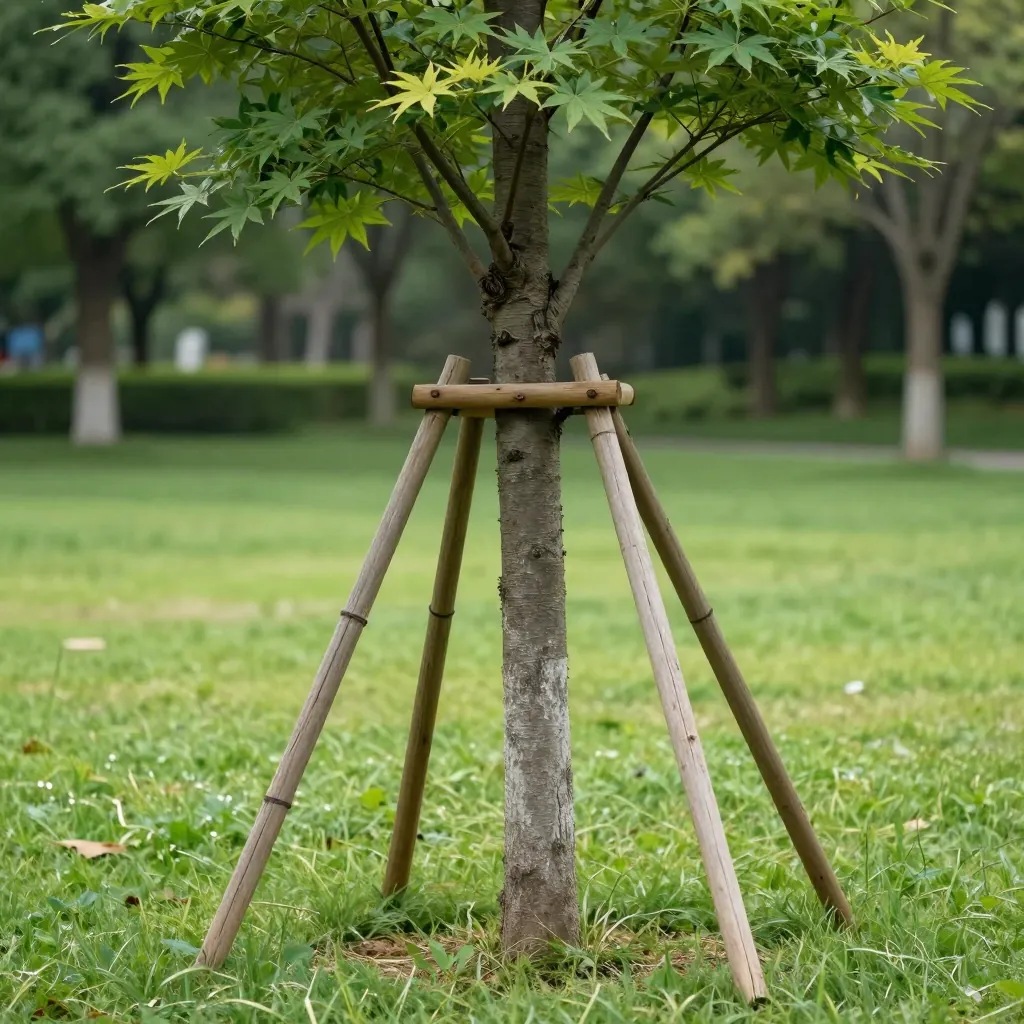
A leaning tree can be straightened if it is young and recently planted: drive a firm stake into the ground on the side opposite the lean, outside the root ball, attach the trunk to it with a wide, flexible tie, and bring the tree upright gradually over one growing season. A large tree that has stood in place for years cannot be pulled straight; with those trees the task is to judge whether the lean is dangerous.
Why Trees Lean
- Light: a shaded tree grows its crown towards the light. This lean is slow and usually harmless.
- Prevailing wind: steady wind from one direction can permanently tilt trees, especially on open sites.
- Poor planting: loose backfill, a loose root ball or planting too deep can make a new tree fall over in the first storm.
- Soil and root problems: waterlogged or eroded ground, roots cut during excavation, or root rot weaken anchorage.
Straightening a Young Tree: Staking Step by Step
- Choose the time: the best moment is when the soil is moist and soft, during dormancy or early spring. A newly planted sapling that has tipped with its root ball can be set upright straight away by opening the soil on the high side, pushing the tree back and firming the soil again.
- Place the stake correctly: drive the stake on the side opposite the lean, outside the root ball (about 30–45 cm from the trunk) and into firm ground. Do not drive it through the root ball. On windy sites two or three stakes can be used.
- Use the right tie: attach the trunk to the stake with a rubber or woven tree tie 2–5 cm wide, in a figure-of-eight between them. Old advice says the tie must “never go around the trunk”; the real rule is never to use bare wire or thin cord, which cut the bark and girdle the trunk. Wide, flexible ties are safe.
- Tie low: fix the tie at the lowest point that keeps the tree upright, usually about one third of its height. The crown should still sway in the wind; that movement makes the trunk thicken and the roots grow stronger.
- Correct gradually: do not force the tree upright in one go. Tighten the tie a little every few weeks over a growing season.
- Check and remove: inspect the ties monthly and loosen them as needed. Stakes and ties should normally come off after one year and at the latest after two growing seasons; left longer, they can grow into the bark and the tree becomes dependent on support.
What About Large Trees?
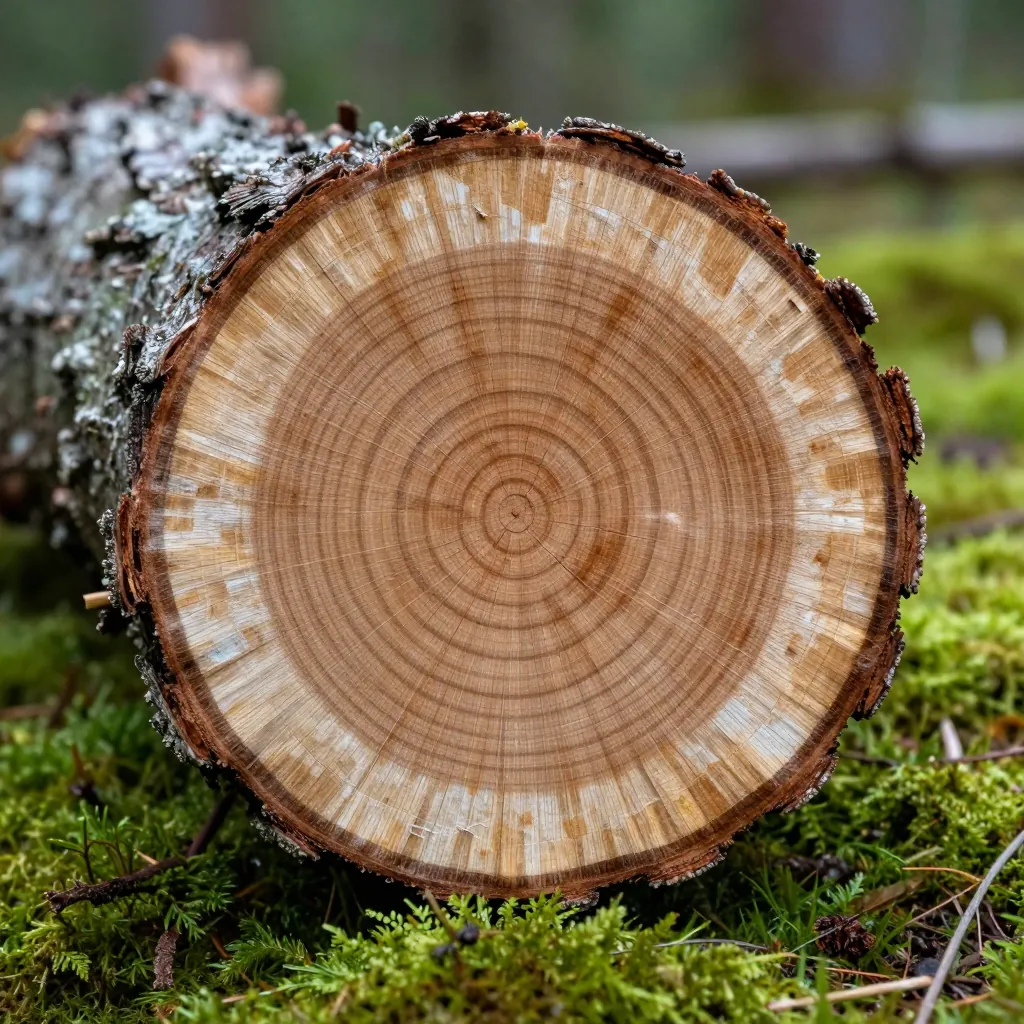
Trying to pull an established tree straight with ropes, winches or vehicles tears its roots and makes it more dangerous. A tree that has leaned over the years has also compensated already by forming reaction wood: conifers lay down compression wood on the underside of the lean, broadleaves lay down tension wood on the upper side, and both bend the crown back upwards. The curve in the trunk is permanent.
Whether a lean is a warning sign depends on these signals:
- a lean that appeared suddenly, for example after a storm;
- soil heaving or cracking, or roots exposed, on the side opposite the lean;
- decay, fungi or deep cracks at the base of the trunk.
If any of these are present, keep people away and call a qualified arborist. They may recommend crown-reduction pruning, flexible cabling between stems and branches, or controlled felling. Felling a leaning tree is especially hazardous because the trunk can split unexpectedly, so it is not a job for amateurs. A tree that has leaned gradually, whose crown has turned upright again and whose roots are sound, is often perfectly safe.
From Leaning Tree to Warped Board
Reaction wood causes trouble in the log too. Normal wood shrinks only about 0.1–0.3 % along the grain, while compression wood can shrink several times more. When normal and reaction wood are in the same board, the board bows or crooks as it dries. That is why strongly leaning stems are downgraded in sawmilling; see our article on ../../../en/blog/log-defects-in-the-timber-industry/.
| Type of warp | What it looks like | Main cause |
|---|---|---|
| Bow | Curves along the face | Reaction wood, poor stacking |
| Crook | Curves along the edge | Reaction wood, internal stresses |
| Cup | Hollows across the width | Difference between tangential and radial shrinkage |
| Twist | Corners not in one plane | Spiral grain, wood near the pith |
How to prevent warped timber
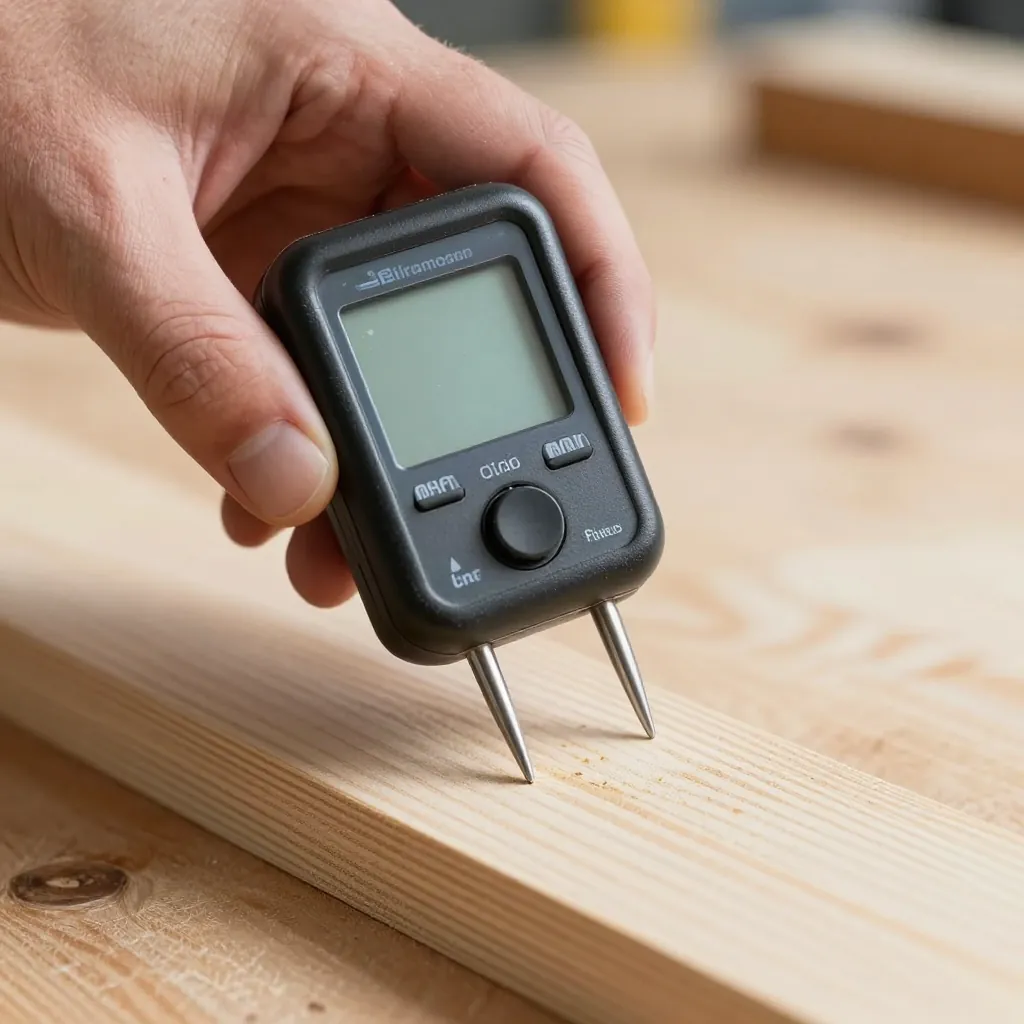
- Controlled kiln drying: drying to the moisture content of the end use with a suitable schedule, followed by conditioning to relieve internal stresses.
- Correct stacking: stickers of equal thickness at regular intervals, aligned vertically, with weight on top of the stack.
- Material selection: rejecting pieces that contain pith, spiral grain or reaction wood.
- Acclimatisation: letting timber adjust to the humidity of the place where it will be used.
Drying too fast can also cause honeycombing, internal checks inside the board. This defect is irreversible and often invisible from the outside, so drying speed has to be matched to species and thickness.
Conclusion
A young tree can be straightened with patience and correct staking; with a large tree, safety comes first. Warped timber is also hard to fix afterwards: slight cupping may ease once moisture evens out, but bow and twist can usually only be removed by planing the board down to a smaller section. The real answer is correct drying from the start. At CNRWOOD timber is kiln-dried, and joining defect-free pieces by ../../../en/blog/what-is-a-finger-joint-in-timber/ and laminating them reduces the tendency of door stiles and beams to warp. See our ../../../en/products/timber/ page for our products.