
Log defects are features that reduce the usable value of wood. They form while the tree grows, or after felling during storage and transport. The main ones are knots, rot and stain, shakes and checks, stem form faults such as sweep and taper, spiral grain, reaction wood and insect holes.
In products made from logs alone, such as sawn timber, solid flooring and sliced veneer, these defects directly decide both yield (how much lumber a log gives) and grade. A large share of losses comes from sawyers who misread a log and choose the wrong sawing pattern for its defects.
Parts of a log and pre-sawing assessment
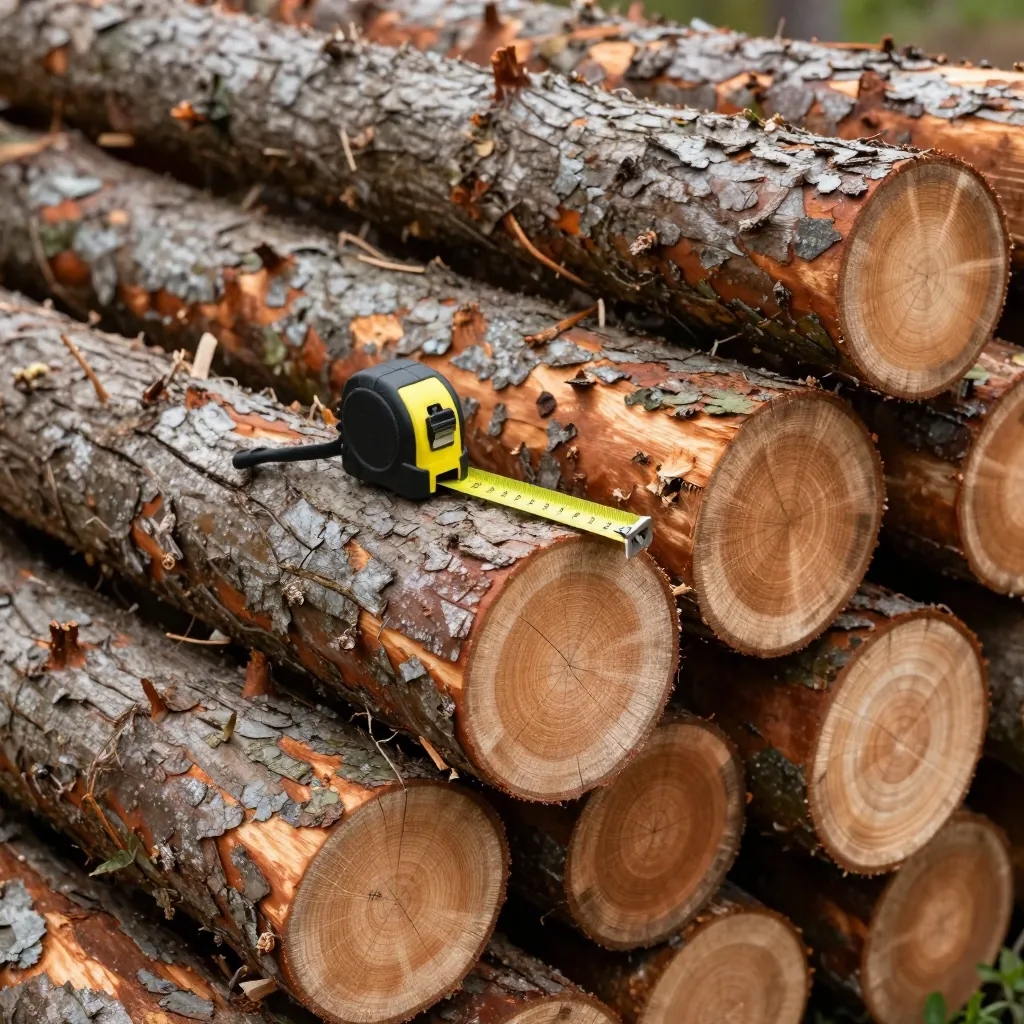
The European terminology standard EN 844 defines roundwood as felled wood with the top removed and all branches cut off, which may be cut into shorter lengths. Value falls from butt to top, because knots become larger and more frequent towards the crown:
- Butt log: taken from the thick end; it has the fewest knots and the highest value, and supplies peeled and sliced veneer and furniture-grade lumber.
- Middle logs: between butt and top, used for general-purpose lumber.
- Top log: from the thin end, better suited to packaging timber and to particleboard and fibreboard.
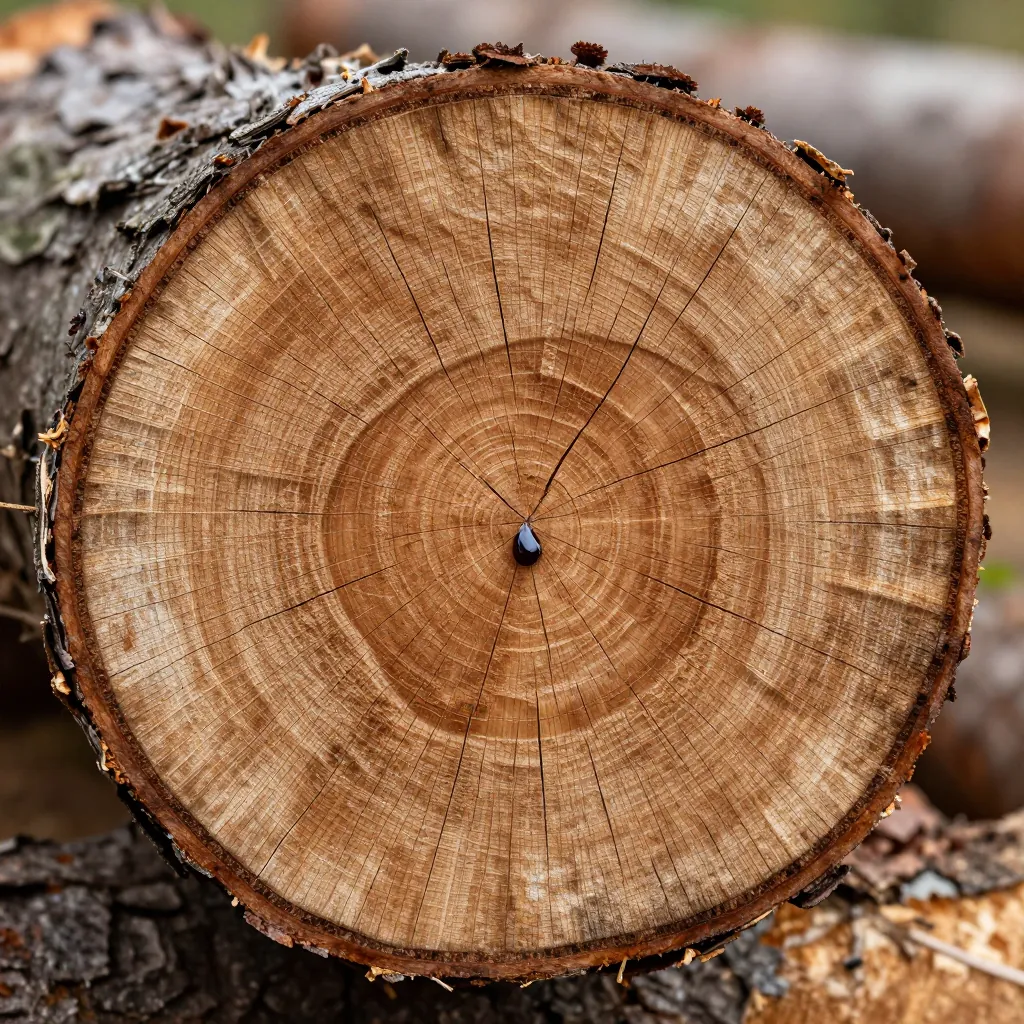
Before sawing, the operator should examine three things: the form (cylindrical or curved), the bark surface (knot scars, spiral grain, swellings, frost ribs, burls, insect holes) and the end face (ring width, position of the pith, heart or ring shakes, rot, stain). How log volume is measured is explained in what is a log.
Stem form defects
Sweep and crook
Curved logs reduce lumber yield and raise processing costs, although natural curvature is sought after for some uses such as boat building. Where possible, curved logs should be sawn through and through, dogged on the carriage with the curve facing up or down.
Taper
Every log narrows from butt to top. Stems that lose roughly 1 cm of diameter per metre are called full or cylindrical; logs that narrow much faster are tapered. In tapered logs the fibres are cut across in the boards, which lowers both yield and strength. Fir, spruce and pine tend to have the fullest stems.
Ovality and eccentric pith
An oval cross-section or a pith far from the centre signals uneven growth. An off-centre pith usually comes with reaction wood, described below, and decides how the log should be turned on the saw.
Fluting and double pith
Fluted stems with an irregular, ribbed cross-section are inherited in hornbeam, yew, cypress and elm, and give low yield. Stems with two or more piths tend to fall apart during sawing, and boards with included bark from the junction should not enter the graded stock.
Structural defects: knots, spiral grain and reaction wood
Knots
Knots form when branches are enclosed by the growing stem and, after rot, are the most important defect. There are two main types:
- Live (intergrown) knots: formed from a living branch, fused with the surrounding wood and held firmly in place.
- Dead (encased) knots: formed when the stub of a dead branch is overgrown. Because they are not fused, are denser than the stem wood and shrink more on drying, they can fall out and leave a hole. They are common in conifers, especially spruce, fir and larch.
Knots reduce static and especially dynamic strength, break up the colour and blunt cutting tools. Some bark marks reveal hidden knots: chevron-shaped scars on thin-barked beech, poplar and birch, and “bark roses” on rough-barked oak. If large knots are concentrated on one face, start sawing from the clear face.
Spiral grain
Instead of running parallel to the stem axis, the fibres wind around it. Sawing cuts many fibres at an angle, so strength drops, twist increases on drying and finishing becomes harder. Lumber from strongly spiral-grained logs should not be used for load-bearing members, and thicker sections (in practice at least 40 mm) are preferable to thin ones.
Reaction wood
Leaning or wind-exposed trees build abnormal wood to keep the stem upright, and the pith shifts to one side. Conifers form compression wood on the lower side of the lean; broadleaves form tension wood on the upper side. Compression wood is hard and brittle and shrinks far more along the grain than normal wood, causing bow and cracks in the lumber. Tension wood pinches the saw and tears the fibres rather than cutting them, leaving a woolly surface. Saw thick sections from compression-wood logs, and always use sharp, well-set saws on tension wood.
Irregular growth rings
Abrupt switches between narrow and wide rings show that hardness and texture are not uniform, which makes machining and drying harder. On the other hand, the wavy rings found in high-altitude spruce and fir have decorative value, and such spruce is prized for stringed instruments.
Shakes and cracks
- Surface and drying checks: as debarked logs dry, wood shrinks more tangentially than radially, so radial checks open from the surface inwards. Small and medium checks should be left in the slabs; deep ones should be placed on the saw line.
- Heart shakes: radial cracks running out from the pith, seen on the end as a star or a line. They are common in summer-felled beech, oak, alder and eucalyptus. Put the deepest crack on the saw line or keep it within a single plank.
- Ring shakes: separation along a growth ring, found in oak, chestnut and fir. Keep small ring shakes within a single piece where possible.
- Frost cracks: in severe cold the outer layers contract faster than the core and the stem splits lengthwise, sometimes with a bang like a gunshot. They occur in oak, elm, ash, chestnut and walnut, mostly in older trees, and leave a raised rib on the stem once they heal.
Biological and mechanical defects
Rot: the most serious defect, caused by fungi. In standing trees heart rot usually attacks the heartwood while the sapwood stays sound, and it is sometimes only discovered after felling. A small core of rot is left in one central plank; extensive rot is removed by sawing a cant. Quality radial lumber must be completely free of rot.
Stain: logs stored too long or badly in the forest or yard develop blue stain and other fungal discolouration. Blue stain barely affects strength but lowers the appearance grade. Shallow stain is removed with the slabs when sawing a cant; deep stain calls for through-and-through sawing, and the boards fall into lower grades.
Insect holes: they cause losses in both volume and grade. Shallow holes are removed by cant sawing; deep holes call for through-and-through sawing.
Wounds: storms, snow, hail and lightning, as well as animals, vehicles and people, leave scars that bring discolouration, included bark and incipient decay.
Sawing strategy by defect
The table summarises the basic approach for the most common defects. Cant sawing means first removing the sides to produce a central cant; through-and-through (live) sawing slices the whole log with parallel cuts.
| Defect | Main effect | Sawing approach |
|---|---|---|
| Heart rot | Loss of yield and grade | Small: keep in one central plank; large: remove with a cant |
| Large knots on one face | Loss of strength and appearance | Start sawing from the clear face |
| Sweep | Short, cross-grained boards | Dog the log with the curve up or down |
| Heart and ring shakes | Boards that split apart | Put the shake on the saw line or in one piece |
| Compression wood | Bow, longitudinal shrinkage | Saw thick sections; clamp on the sound side |
| Tension wood | Woolly surface, pinched saw | Use sharp, well-set saws |
| Shallow stain and insect holes | Lower grade | Remove the outer zone by cant sawing |
When an oval log without reaction wood is sawn through and through, keep its larger diameter parallel to the saw blade to get wider boards. If reaction wood is present, set the larger diameter perpendicular to the blade so the defect does not end up in every board. The general logic of sawing patterns is covered in from log to lumber.
Summary
The grade of sawn timber depends on production faults such as uneven thickness, roughness and wavy sawing, and on wood defects such as knots, shakes, rot, stain and spiral grain. Most of these originate in growing conditions, some in storage after felling. Recognising a defect and sawing the log accordingly yields far more value from the same raw material. Remaining knots and defects can be cut out later: in finger jointing, defective zones are removed and clear pieces are joined end to end. CNRWOOD’s finger-jointed door stile is made on this principle from kiln-dried, graded timber.