
A log is the roughly cylindrical section of a tree stem that remains after the tree has been felled, its branches and crown removed and the stem cut to a set length. Logs are the raw material for sawn timber, veneer, plywood and poles, and they are the first traded product on the way from forest to factory.
Log volume is measured in cubic metres (m³): Volume = π × (mid-diameter / 2)² × length. A log with a mid-diameter of 50 cm and a length of 6 m therefore holds 3.1416 × 0.25² × 6 = 1.178 m³. Below you will find the logic behind the formula, the most common mistakes and a quick reference table.
How a log is produced
After the tree is felled at the stump, the branches are trimmed flush with the stem, the thin top is removed and the stem is cross-cut into lengths. This step is called bucking. A good bucker reads the stem for sweep, knots, splits and rot and places the cuts so that the most valuable parts give the most timber with the least waste.
- Butt log: the thick lowest section next to the stump. It has the fewest knots and the highest value, and supplies veneer and high-grade lumber.
- Middle logs: the sections between butt and top, suitable for general-purpose lumber.
- Top log: the thin, knotty section near the crown, mostly used for packaging timber, pulp or particleboard.
Logs can be stored with or without bark in the forest or at the mill yard. If they have to wait for long, the ends are sealed or the piles are kept wet with sprinklers to limit end splits, blue stain and insect attack. Our article on log defects explains what to look for.
The log volume formula
A log tapers slightly from butt to top, so in practice it is treated as a cylinder with the diameter measured at its middle. This is known as Huber’s formula:
V = π × r² × L, which is the same as V = (π / 4) × d² × L
- V: volume (m³)
- d: diameter measured at the exact middle of the log (m); r is half of it
- L: length of the log (m)
- π: 3.1416 (22/7 is only an approximation)
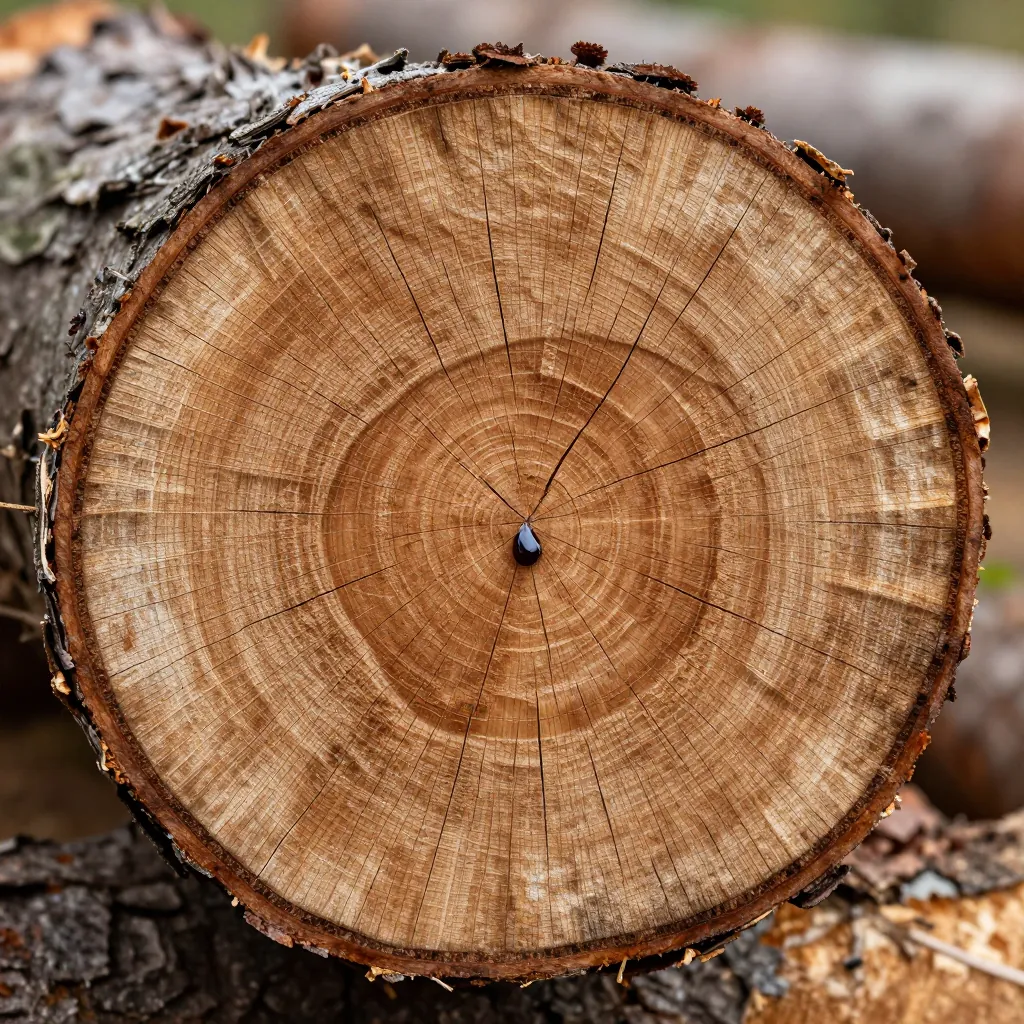
Diameter is normally measured under bark. If you measure over bark, subtract twice the bark thickness; for thick-barked pines the difference can exceed 10 percent of the volume. On oval logs, measure two diameters at right angles and use the average.
Worked example: 50 cm diameter, 6 m length
- Convert the diameter to metres: 50 cm = 0.50 m, so the radius r = 0.25 m.
- Square the radius: 0.25 × 0.25 = 0.0625 m².
- Multiply by π to get the cross-section: 3.1416 × 0.0625 = 0.19635 m².
- Multiply by the length: 0.19635 × 6 = 1.178 m³.
That is 1 m³ plus 178 dm³ (1 m³ = 1000 dm³). The classic mistake is to mix units, entering the radius in centimetres and the length in metres: 3.14 × 25 × 25 × 6 gives a meaningless 11,775. Convert every measurement to metres first and the problem disappears.
Quick reference: log volumes per 1 m and 4 m length
| Mid-diameter | Cross-section | 1 m length | 4 m length |
|---|---|---|---|
| 20 cm | 0.0314 m² | 0.031 m³ | 0.126 m³ |
| 30 cm | 0.0707 m² | 0.071 m³ | 0.283 m³ |
| 40 cm | 0.1257 m² | 0.126 m³ | 0.503 m³ |
| 50 cm | 0.1963 m² | 0.196 m³ | 0.785 m³ |
| 60 cm | 0.2827 m² | 0.283 m³ | 1.131 m³ |
The table shows that volume grows with the square of the diameter: double the diameter and the volume quadruples. A measuring error of a few centimetres therefore turns into a real price difference across a large consignment.
Other ways to measure
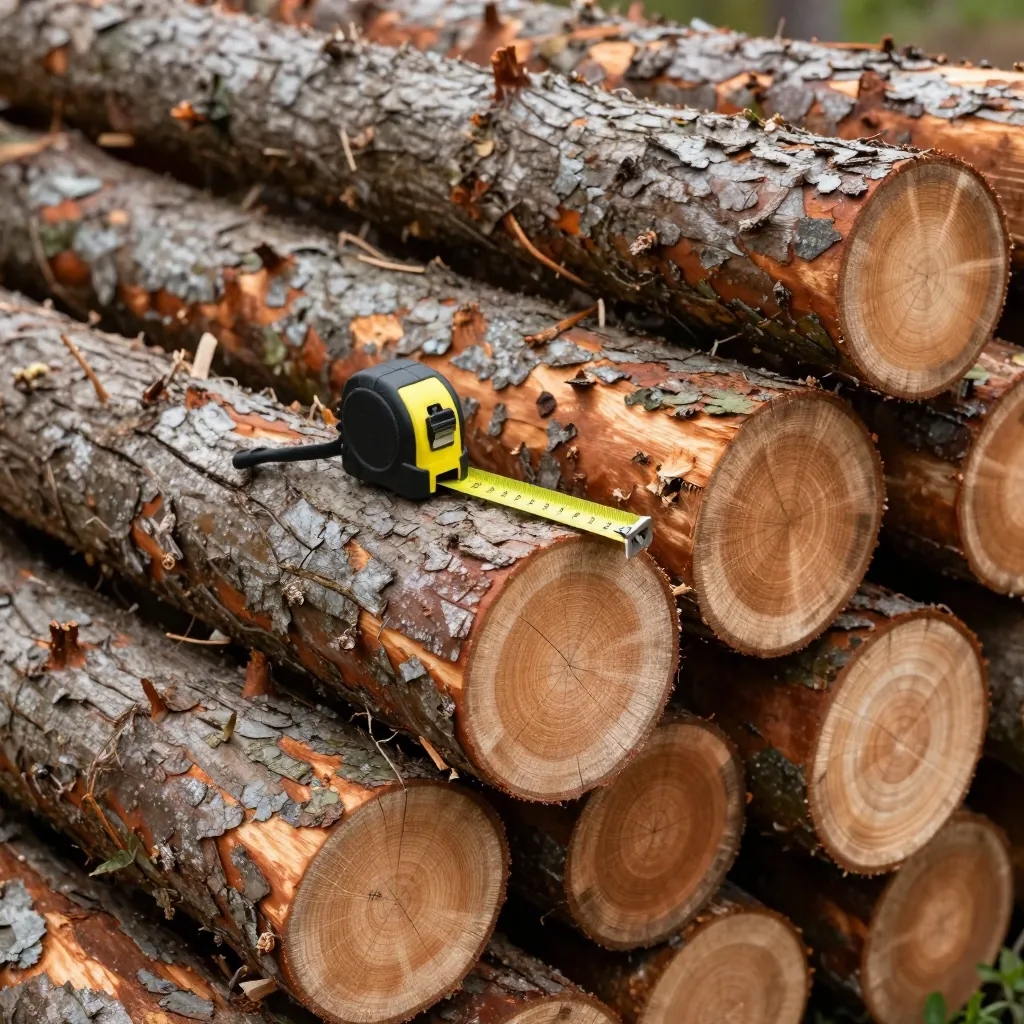
When the middle of the log cannot be reached, for example in a stacked pile, the two end diameters are used instead. Smalian’s formula averages the areas of the two end faces and multiplies by the length; because logs taper, it gives a slightly higher result than Huber’s formula. In the UK and some Commonwealth markets the older Hoppus measure is still quoted, which deliberately gives a smaller figure than the true volume. Firewood and pulpwood are often not measured log by log at all but sold by the stacked cubic metre (stere), which contains noticeably less solid wood than 1 m³ because of the air gaps.
How much lumber does a log yield?
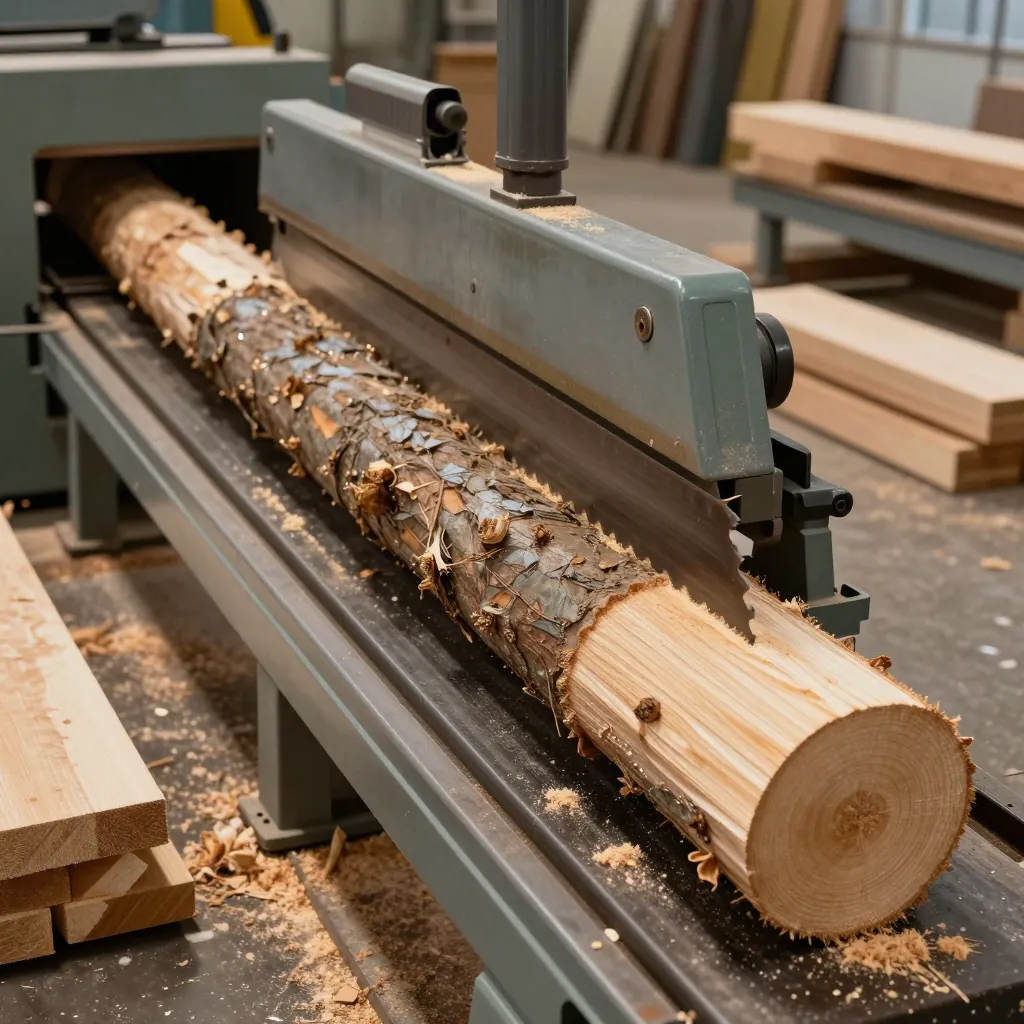
Log volume is not lumber volume. Once bark, rounded slabs, saw kerf and defective parts are removed, the sawn output is typically around half of the log volume. The exact recovery depends on diameter, length, taper, defects and the sawing pattern; large, straight, cylindrical logs give the best yield. We explain the sawing patterns in from log to lumber and the lumber volume calculation in what is timber.
Summary
An accurate log calculation starts with an under-bark mid-diameter, all units in metres and the correct value of π. Instead of doing the arithmetic by hand, you can enter diameter and length in our log volume calculator and get the result instantly. CNRWOOD supplies dried and graded lumber; see our timber and panel range for available sizes.