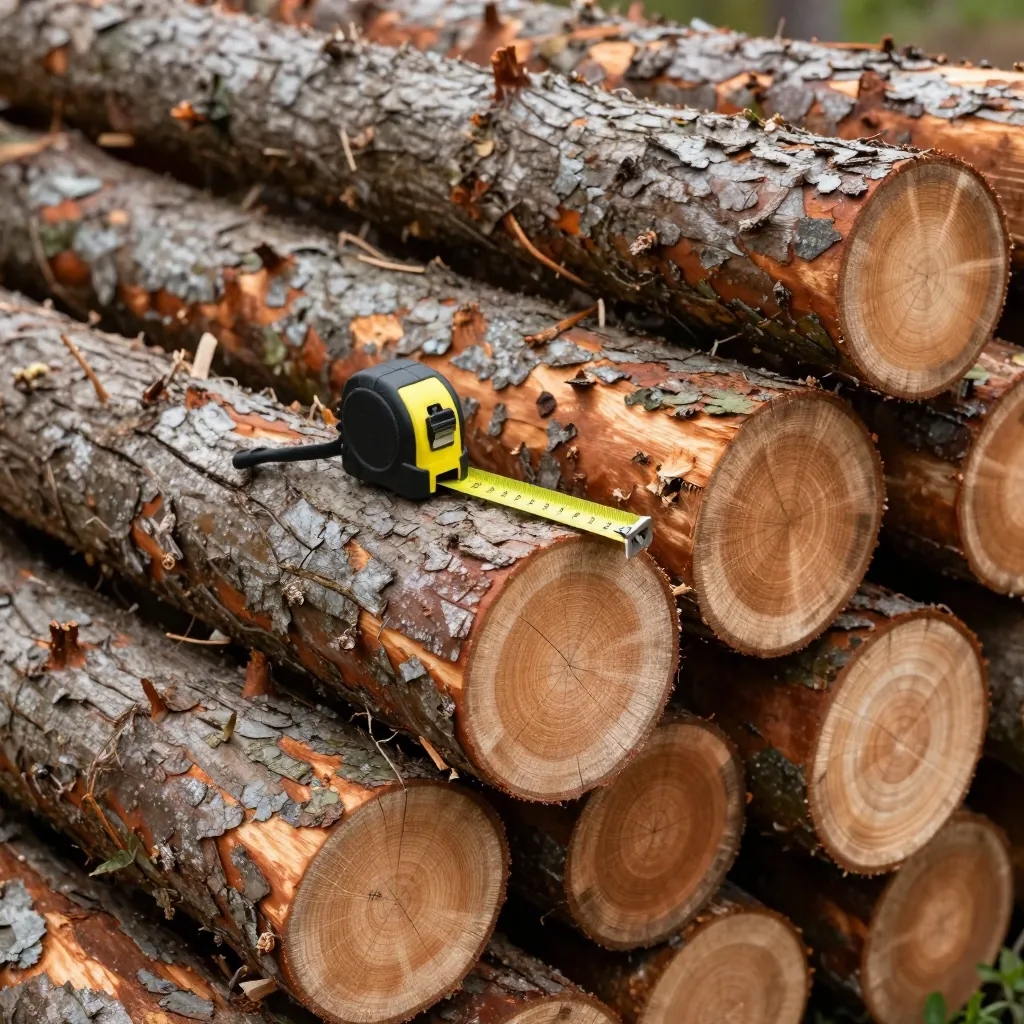

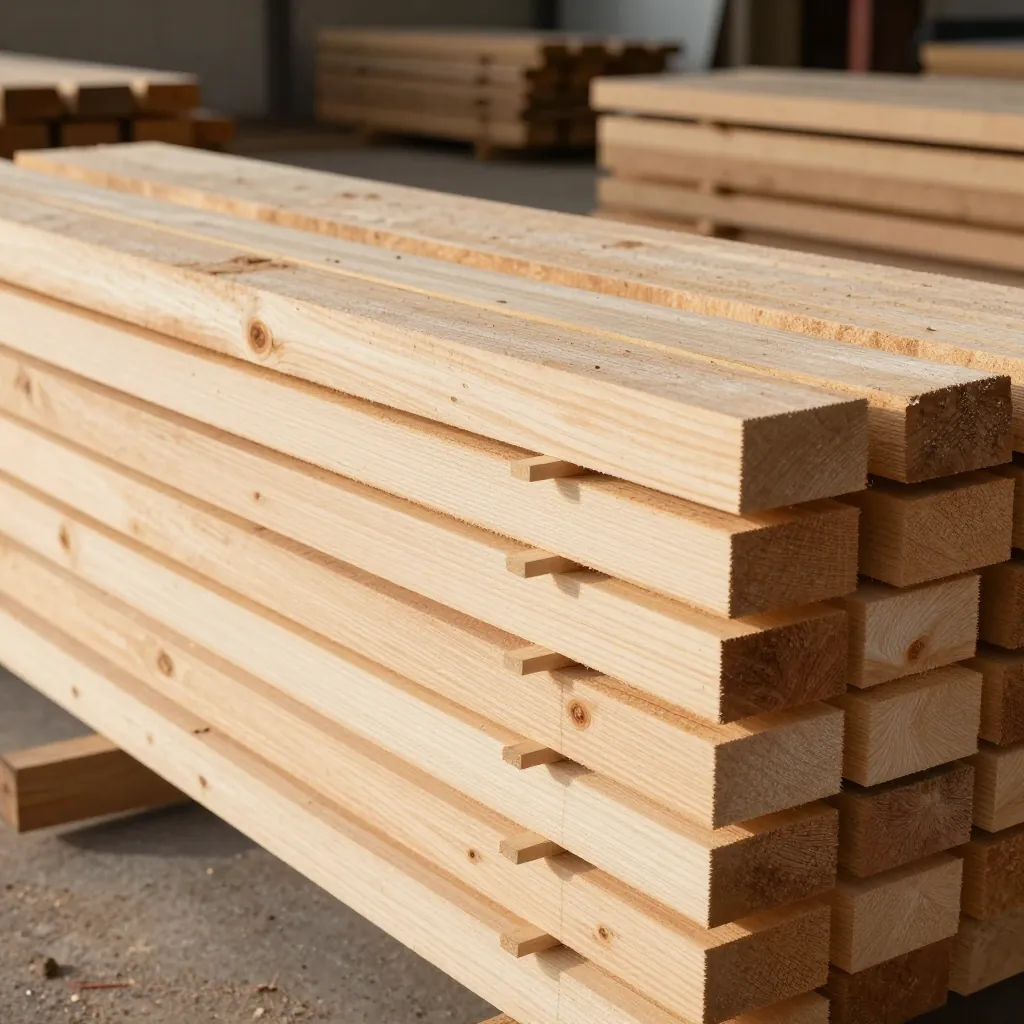
Timber, called lumber in North America, is wood that has been sawn lengthwise from logs into pieces of a set thickness, width and length with a rectangular cross-section. Most of the wooden things around us, from furniture and doors to roofs and packaging, start as sawn timber.
Timber is bought and sold by the cubic metre (m³), and its volume is simply thickness × width × length. A piece of 5 cm × 10 cm × 4 m is 0.05 × 0.10 × 4 = 0.02 m³, or 20 dm³, so one cubic metre holds 50 such pieces.
How timber is produced
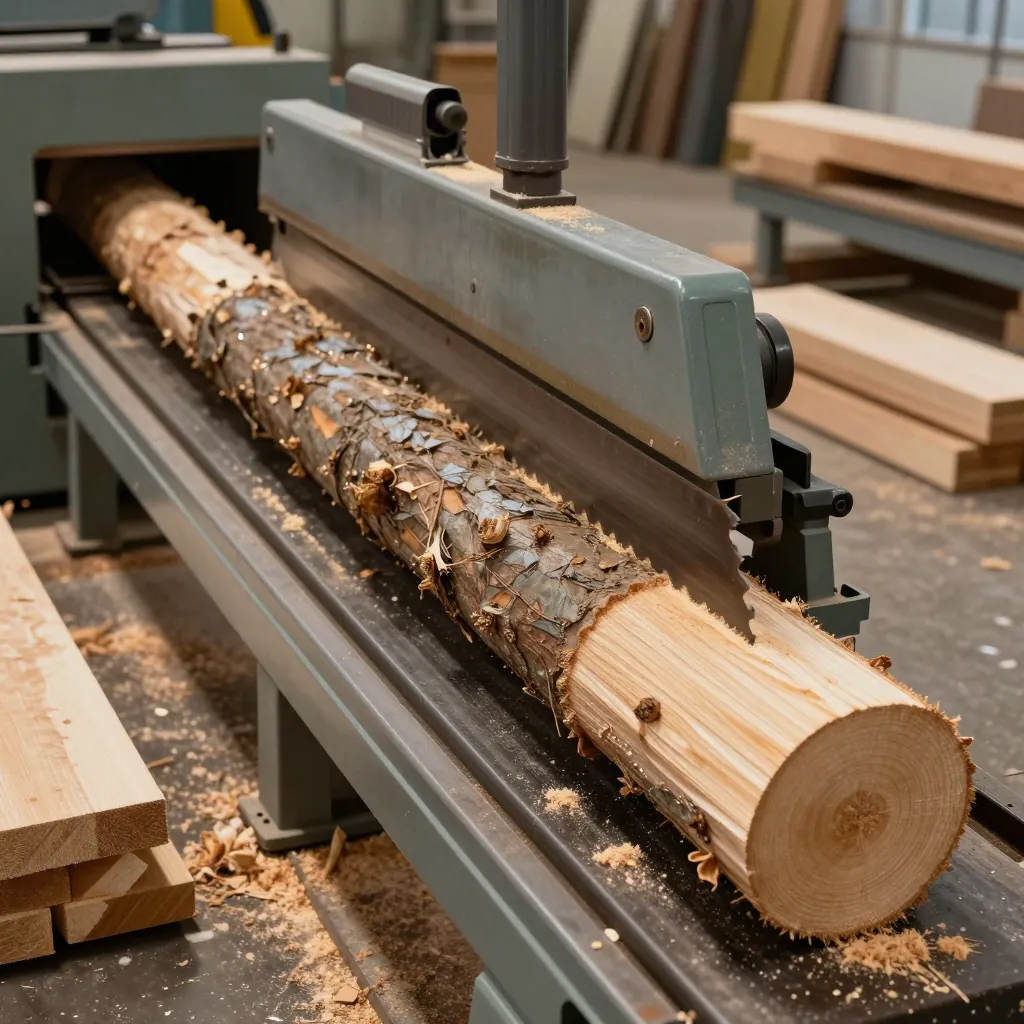
Felled trees are delimbed and cut into logs, which go to a sawmill. There they are sawn on band or circular saws, edged, trimmed to length and graded. The timber is then air-dried or kiln-dried and, where required, planed, heat-treated or preservative-treated. The sawing patterns are covered in detail in from log to lumber.
According to FAO statistics, roughly half of all wood harvested worldwide is still burned as fuel. The other half is industrial roundwood, part of which becomes sawn timber while the rest goes into pulp, chips and wood-based panels.
Main types of timber
- Unedged (waney-edge) boards: sawn on two faces only, with bark and the natural curve of the stem left on the edges.
- Edged timber: sawn on all four sides with a rectangular section, the most common commercial form.
- Planed timber (PAR): planed all round after drying, giving exact dimensions and a smooth surface.
- Heat-treated (stamped) timber: treated to ISPM 15 and marked with the IPPC stamp for export packaging.
Timber is also named by its section: thin, wide pieces are boards or planks, thick pieces are battens or beams, square sections are often called squares or posts, and small strips are laths or slats. By species there are softwoods such as spruce, pine and fir, and hardwoods such as oak, beech and iroko; the two groups behave quite differently in use.
Why moisture content matters
Freshly sawn timber usually holds more than 30 percent moisture. Wood starts to shrink and can distort once it dries below its fibre saturation point of around 28–30 percent, so it should be dried close to the humidity of the place where it will be used:
- Air drying typically brings timber down to about 15–20 percent.
- Interior joinery and furniture timber is kiln-dried to 8–12 percent.
- Lamellae for glulam and CLT are typically dried to 12 ± 2 percent.
Timber that has not been dried properly will check, warp and open its joints later, and stays vulnerable to mould and blue stain.
How to calculate lumber volume
Convert every dimension to metres and multiply: V (m³) = thickness (m) × width (m) × length (m) × number of pieces. Quantities below 1 m³ are often given in cubic decimetres. Since 1 m³ = 1000 dm³, 1.7 m³ is 1700 dm³ and 0.236 m³ is 236 dm³.
Example: 50 boards of 2.5 cm × 15 cm × 4 m give 0.025 × 0.15 × 4 = 0.015 m³ each, or 0.75 m³ in total. To work backwards, divide one cubic metre by the volume of a single piece: 1 ÷ 0.015 ≈ 66 pieces.
| Section (thickness × width) | One piece, 4 m long | Pieces per m³ |
|---|---|---|
| 2.5 × 10 cm | 0.010 m³ | 100 |
| 2.5 × 15 cm | 0.015 m³ | about 66 |
| 5 × 10 cm | 0.020 m³ | 50 |
| 5 × 15 cm | 0.030 m³ | about 33 |
| 10 × 10 cm | 0.040 m³ | 25 |
Two details matter in practice. The first is net size: after drying and planing, a piece can be a few millimetres smaller than its sawn size, so agree which size the price is based on. The second is length allowance: some sellers measure length including a trimming allowance.
How to choose good timber
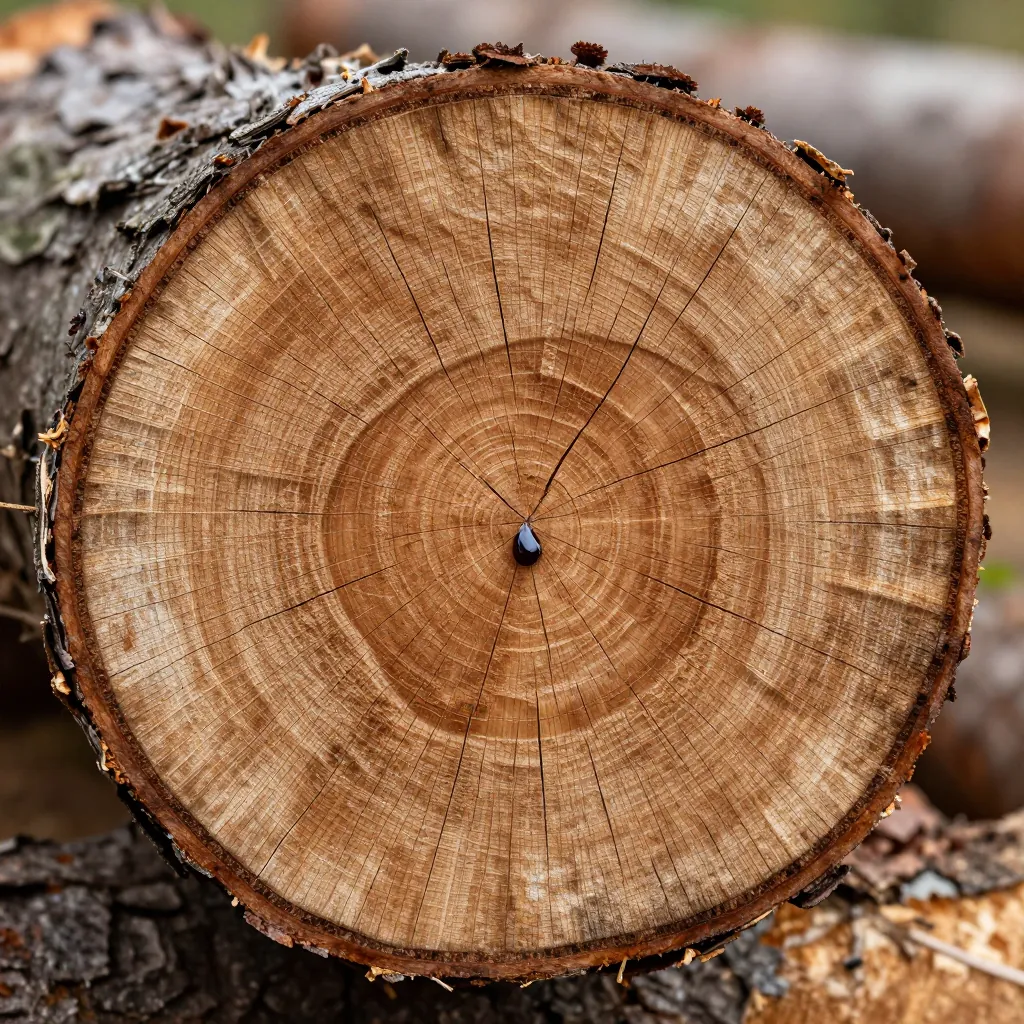
- Species and origin: slow-grown wood with tight growth rings is more stable and stronger.
- Defects: the size and number of knots, splits, rot and spiral grain set the grade.
- Moisture: it should match the end use; a moisture meter makes this easy to check.
- Structural use: load-bearing timber should carry a strength class such as C24 under EN 338.
- Storage: dry, ventilated, off the ground and stacked on sticks keeps timber in good condition.
Summary
Timber is the log turned into dimensioned, usable material, and its value depends on species, defects and drying quality. To get quantities right before ordering, use our lumber calculator. Besides spruce and iroko timber, CNRWOOD supplies okoume plywood and OSB-3 boards; see timber and panels for details.