

Wood is one of the oldest building and tool materials known to humankind. The oldest known wooden structure is a pair of deliberately notched, interlocking logs found at Kalambo Falls in Zambia and dated to about 476,000 years ago. The Schöningen spears from Germany are among the oldest hunting weapons, and the roughly 11,500-year-old Shigir Idol from Russia is the oldest known wooden sculpture.
Because wood decays easily, it leaves far fewer traces in the archaeological record than stone or bone. The examples we know survived in exceptional, oxygen-free settings such as bogs, peat or waterlogged sediment, so the real history of wood use is very probably older still. Even the Turkish word for timber, “ahşap”, has a long history: it comes from “akhshāb”, the plural of the Arabic “khashab” (wood).
The world’s oldest wooden artefacts
| Artefact | Location | Approx. age | Significance |
|---|---|---|---|
| Kalambo Falls structure | Zambia | 476,000 years | Oldest known wooden structure |
| Clacton spear point | England | 400,000 years | One of the oldest wooden tools |
| Schöningen spears | Germany | 300,000 years (recent studies suggest they may be younger) | Oldest known complete hunting spears |
| Shigir Idol | Ural Mountains, Russia | 11,500 years | Oldest known wooden sculpture |
| Ljubljana Marshes Wheel | Slovenia | 5,150 years | One of the oldest wooden wheels |
| Khufu ship | Giza, Egypt | 4,500 years | Large ceremonial boat of Lebanese cedar |
| Midas Mound tomb chamber | Gordion, Türkiye | 2,750 years | One of the oldest standing wooden structures |
| Hōryū-ji temple | Nara, Japan | 1,300 years | One of the oldest surviving wooden buildings |
The Kalambo find was published in 2023. It predates the appearance of Homo sapiens and shows that early human species shaped wood not only into tools but into structures. The Shigir Idol was found in 1890 in a peat bog in the Urals. Carved from larch and decorated with faces, its surviving parts stand about 2.8 metres tall.
From the first settlements to ancient civilisations
When Neolithic people settled down, they built houses with timber posts, wattle walls and thatched roofs. Timber-lined water wells about 7,000 years old found in Central Europe are among the oldest known wooden constructions. The wheel, as the Ljubljana example shows, was also invented in wood.
Egypt, poor in trees, imported cedar from Lebanon for ships, coffins and furniture; the Khufu ship at Giza is the most famous example. In Anatolia, the tomb chamber of the Midas Mound at the Phrygian capital Gordion, built of juniper and pine logs, has been dated by tree-ring analysis to around 740 BC and is considered one of the oldest standing wooden structures in the world.
Woodworking also flourished on the steppes of Central Asia. In the Pazyryk kurgans of the Altai Mountains (6th–3rd centuries BC), permafrost preserved wooden burial chambers, carved coffins, horse harness and carts. V. V. Radloff carried out the first excavations in the region in 1865, and S. I. Rudenko led the major Pazyryk excavations in the 20th century. The finds are now in the Hermitage Museum in St Petersburg.
Wood in Islamic art and in Anatolia
Early Islamic art used wood for minbars, doors, ceilings and screens, with rich carving of vine leaves and arabesques. Fatimid-period doors and panels in Cairo are important examples of this tradition.
The Seljuks raised woodworking to an art form. Using kündekâri, a technique of interlocking pieces assembled without nails or glue, together with carving and painting, they made minbars, lecterns, Qur’an stands, cenotaphs and window shutters. The minbar of the Alaeddin Mosque in Konya (12th century) is the oldest dated Seljuk wooden minbar in Anatolia. Walnut, pear, apple, lime, oak and cedar were used alongside imported woods such as ebony.
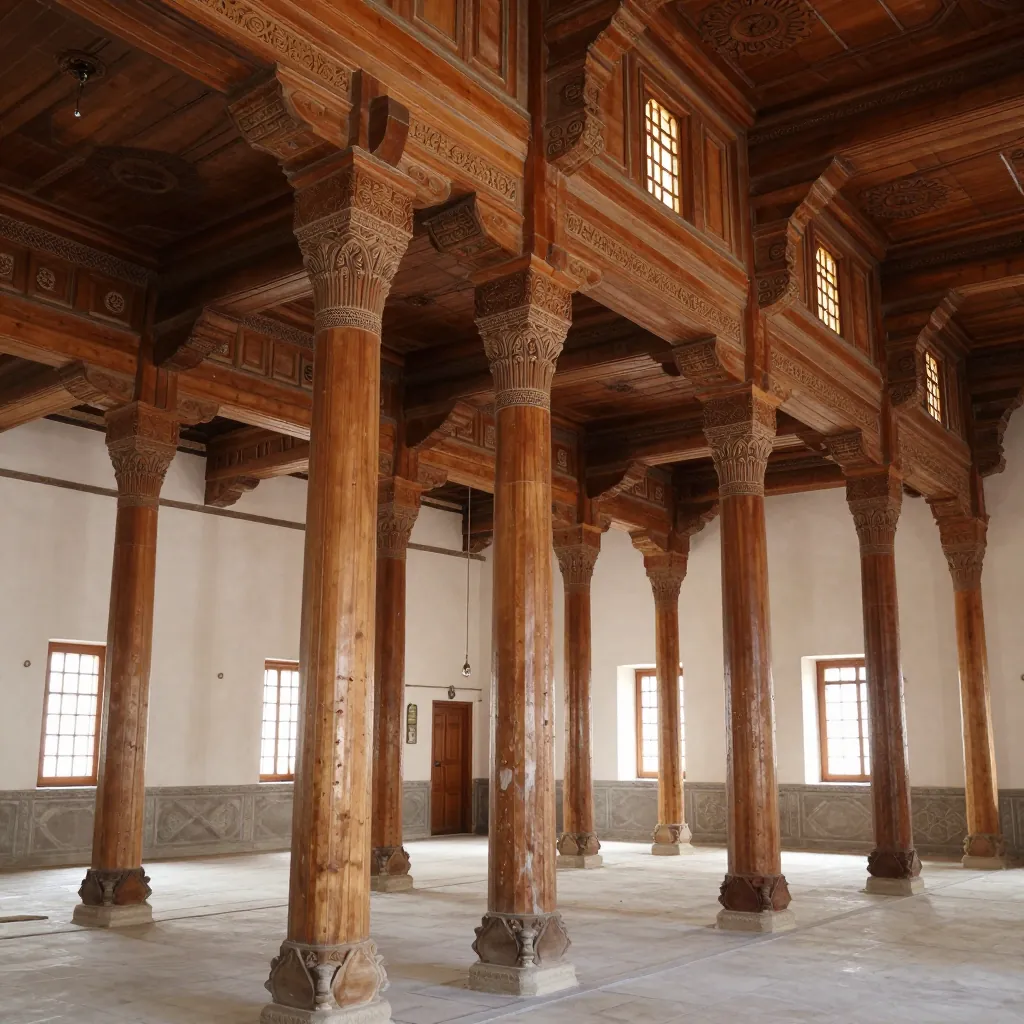
The most distinctive works of the period are mosques whose roofs rest on wooden columns. Afyonkarahisar Grand Mosque, Ankara Arslanhane Mosque, Beyşehir Eşrefoğlu Mosque, Kastamonu Kasaba Mahmut Bey Mosque and Sivrihisar Grand Mosque were inscribed on the UNESCO World Heritage List in 2023 as the “Wooden Hypostyle Mosques of Medieval Anatolia”. Eşrefoğlu Mosque, built at the end of the 13th century, stands out for its cedar columns, painted timber ceiling and a snow pit, filled with snow in winter, that is thought to have helped keep the wood’s moisture balanced.
In the Ottoman period, the palace workshops at Topkapı trained master woodworkers. In civil architecture, the waterside mansions of Istanbul and the houses of Safranbolu, Kula, Mudurnu and Kütahya are fine examples of the timber-frame tradition; Safranbolu has been a UNESCO World Heritage Site since 1994.
Timber architecture around the world
- Japan: the main buildings of Hōryū-ji date from the late 7th to early 8th century and are among the oldest surviving wooden buildings in the world.
- Norway: the 12th-century Urnes Stave Church is a UNESCO World Heritage Site.
- Europe: half-timbered houses and large roof trusses show how long timber lasts when it is kept dry.
The modern era: glulam and CLT
Steel and concrete spread in the 19th and 20th centuries, but wood returned with new technology. Glued laminated timber (glulam), patented by the German master carpenter Otto Hetzer in 1906, made long-span timber beams possible; we explain it in our article on laminated timber. CLT (cross-laminated timber), developed in Austria and Germany in the 1990s, took wood into multi-storey buildings, and timber buildings over 80 metres tall now exist.
Being renewable and storing carbon in its structure, this ancient material has become one of the sustainable building materials of the 21st century.
Conclusion
From the notched logs of Kalambo to today’s CLT buildings, wood has accompanied humankind through every period of its history. At CNRWOOD we carry this long tradition forward with CLT, glulam and timber structures.